Stanford Summer Program
Looking beyond a good idea to build a coherent advantage
ROLE
Pre-Collegiate Summer Institutes Student
Duration
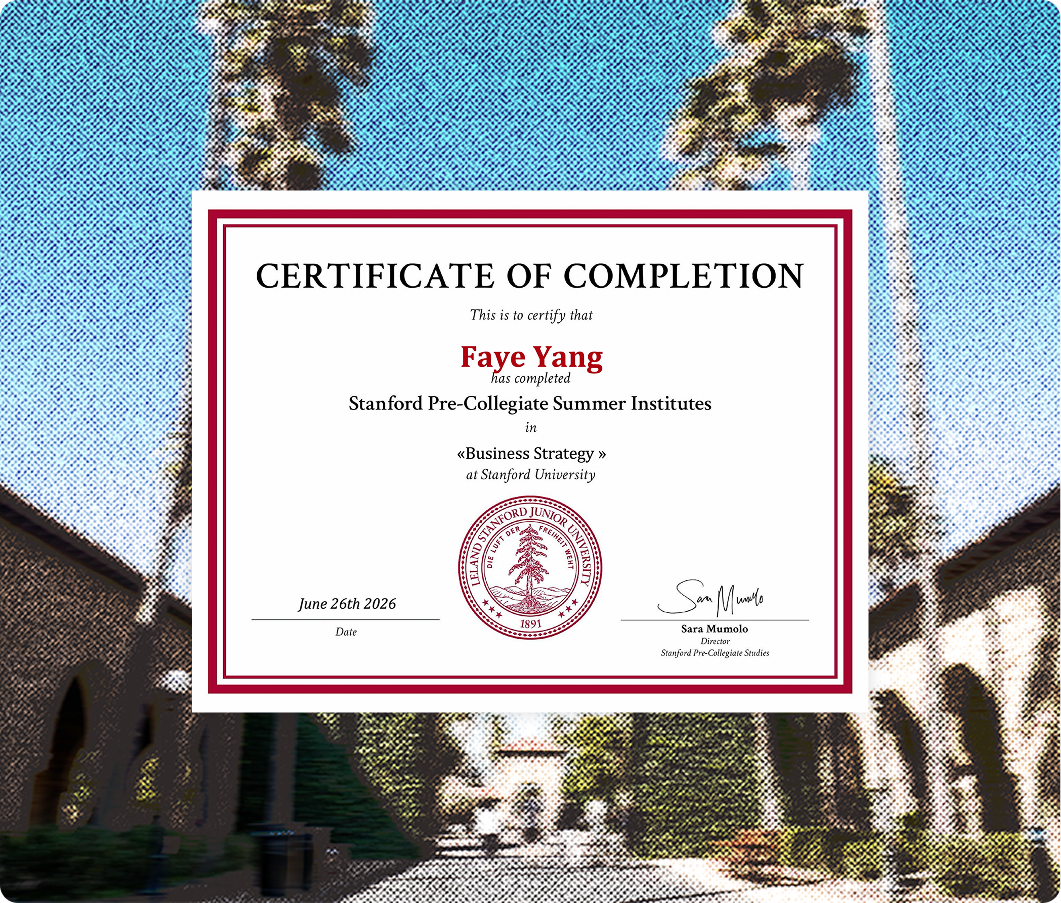
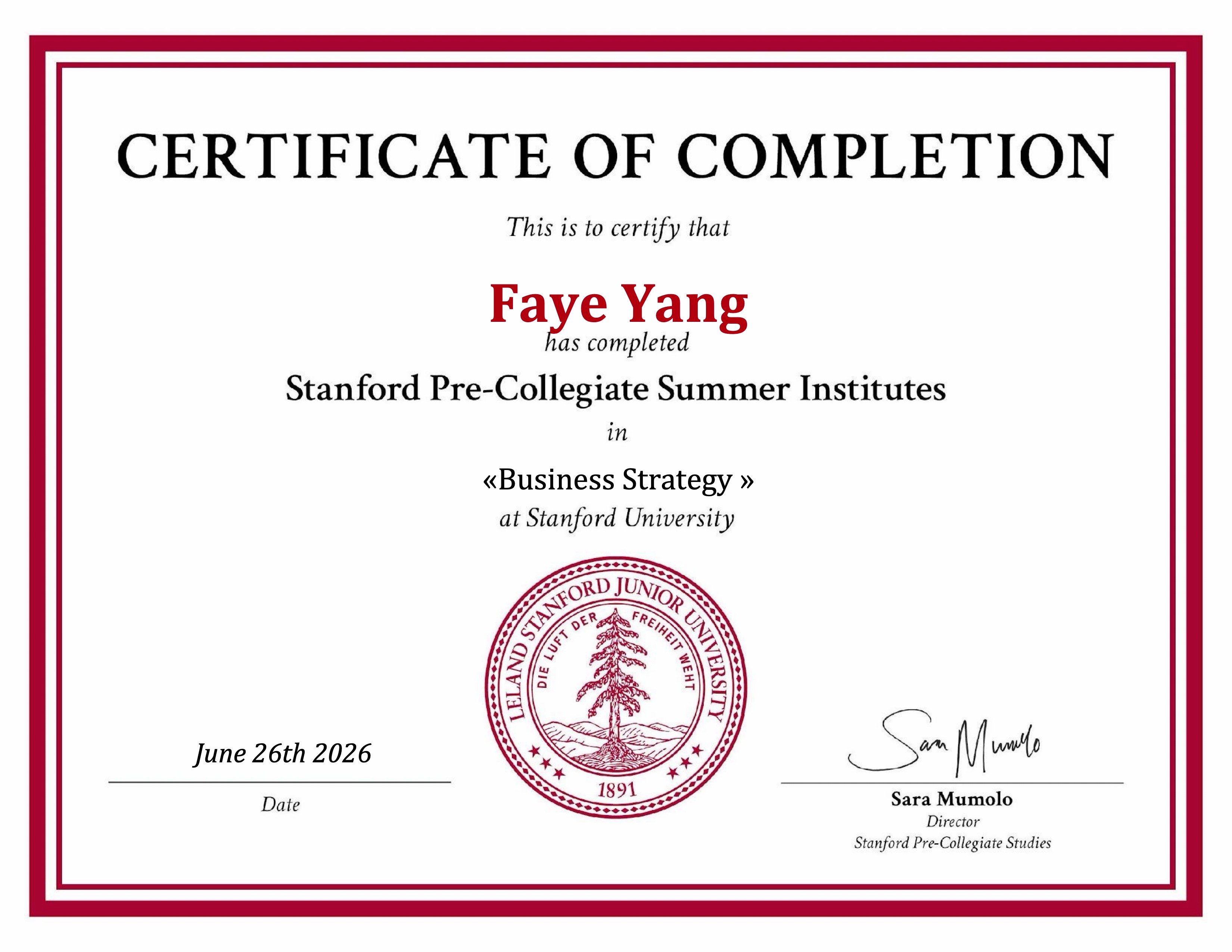
June 15 - June 26, 2026
Course
BUSINESS STRATEGY
Course Focus
How do companies build lasting competitive advantage?
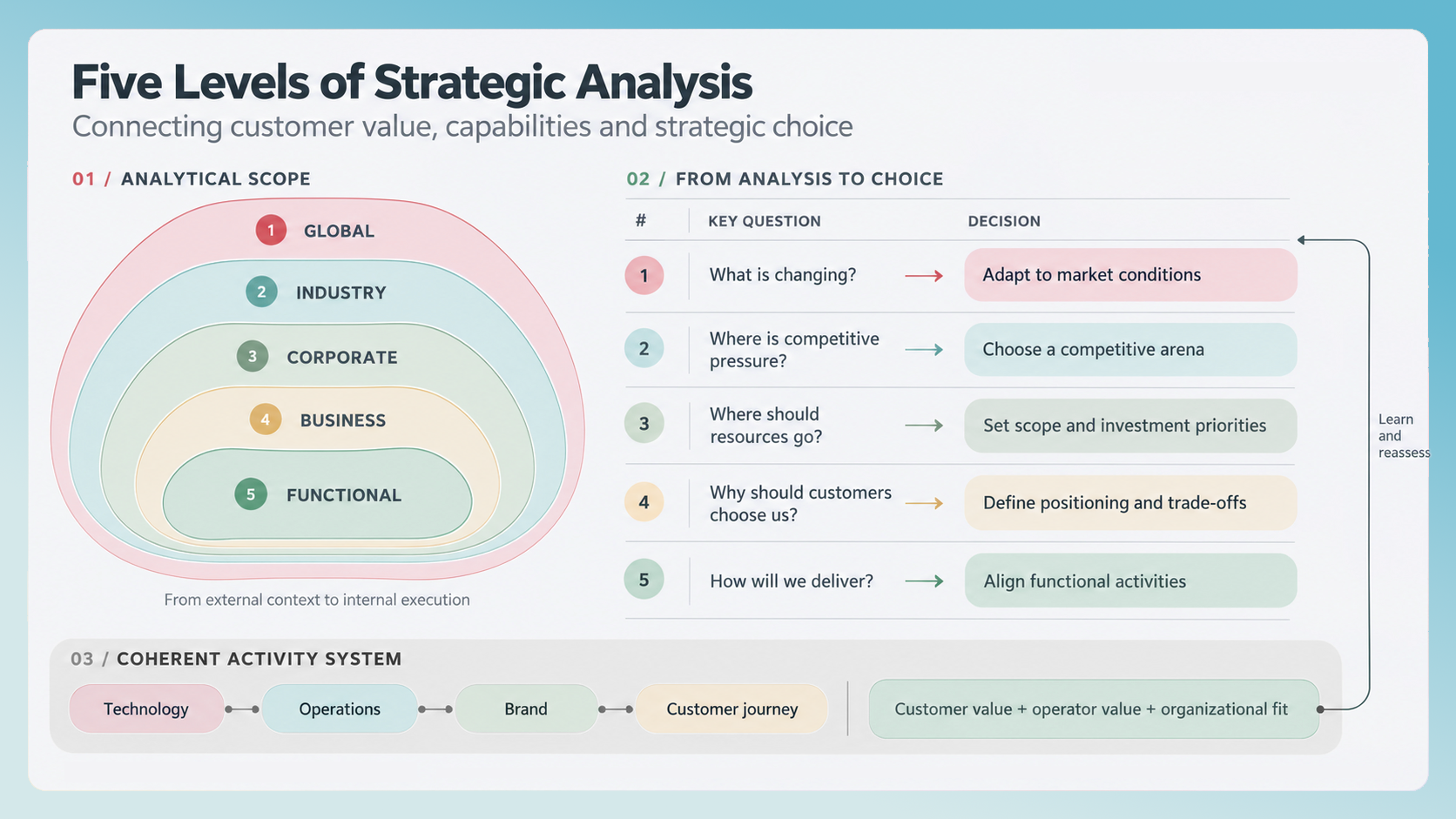
Business Strategy examined how companies create and sustain competitive advantage across global, industry, corporate, business, and functional levels. The course moved from strategic vision to analysis and formulation, showing that strategy is not a single decision or an ambitious statement. It is a connected set of choices about where an organization competes, what value it offers, which resources it prioritizes, and how its activities reinforce one another. Studying real-world examples helped me distinguish a promising idea from a defensible strategy. I learned to look beyond what a company wants to build and ask why customers would choose it, how competitors might respond, and whether the organization can execute consistently over time. This framework gave me a more disciplined way to evaluate businesses and made me more attentive to the trade-offs hidden behind growth, differentiation, and long-term direction.
From Product Thinking to Strategic Choice
Connecting customer value, capabilities, and competition
Before this course, I often approached projects by starting with the user problem and the experience I wanted to improve. Business Strategy added another layer: a useful solution must also fit a clear market position and an organization's capabilities. When reconsidering hospitality and consumer projects, I began asking how a concept creates value for both the customer and the operator, which features are essential to its advantage, and what should not be pursued. I also became more aware that differentiation needs to be supported by a coherent system rather than a single attractive feature. A service can feel distinctive because its technology, operations, brand, and customer journey work together. This perspective helped me connect product thinking with business judgment and gave me a stronger foundation for evaluating whether an idea can remain relevant as competitors, customer expectations, and market conditions change.
Learning Process
Building discipline in an intensive format
The two-week online session required daily live participation, with additional office hours and approximately two to three hours of asynchronous work each day. That structure demanded consistency and preparation. I had to manage my time independently, arrive ready to engage, and continue working after the live class ended. The format showed me that online learning can still be intensive when discussion, assignments, and reflection are treated as one continuous process.
What I Took Away
Asking better questions about a business
The course changed the questions I ask when examining a company. Instead of focusing only on what a business offers, I now look at whom it serves, what trade-offs it makes, how its activities support one another, and where its advantage may weaken. Strategy became less abstract and more practical: a way to connect customer value, organizational choices, competition, and execution. This approach now shapes how I analyze brands, services, and my own project ideas.


2026 FAYE
Stanford Summer Program
Looking beyond a good idea to build a coherent advantage
ROLE
Pre-Collegiate Summer Institutes Student
Duration
June 15 - June 26, 2026
Course
BUSINESS STRATEGY
Course Focus
How do companies build lasting competitive advantage?
Business Strategy examined how companies create and sustain competitive advantage across global, industry, corporate, business, and functional levels. The course moved from strategic vision to analysis and formulation, showing that strategy is not a single decision or an ambitious statement. It is a connected set of choices about where an organization competes, what value it offers, which resources it prioritizes, and how its activities reinforce one another. Studying real-world examples helped me distinguish a promising idea from a defensible strategy. I learned to look beyond what a company wants to build and ask why customers would choose it, how competitors might respond, and whether the organization can execute consistently over time. This framework gave me a more disciplined way to evaluate businesses and made me more attentive to the trade-offs hidden behind growth, differentiation, and long-term direction.
From Product Thinking to Strategic Choice
Connecting customer value, capabilities, and competition
Before this course, I often approached projects by starting with the user problem and the experience I wanted to improve. Business Strategy added another layer: a useful solution must also fit a clear market position and an organization's capabilities. When reconsidering hospitality and consumer projects, I began asking how a concept creates value for both the customer and the operator, which features are essential to its advantage, and what should not be pursued. I also became more aware that differentiation needs to be supported by a coherent system rather than a single attractive feature. A service can feel distinctive because its technology, operations, brand, and customer journey work together. This perspective helped me connect product thinking with business judgment and gave me a stronger foundation for evaluating whether an idea can remain relevant as competitors, customer expectations, and market conditions change.
Learning Process
Building discipline in an intensive format
The two-week online session required daily live participation, with additional office hours and approximately two to three hours of asynchronous work each day. That structure demanded consistency and preparation. I had to manage my time independently, arrive ready to engage, and continue working after the live class ended. The format showed me that online learning can still be intensive when discussion, assignments, and reflection are treated as one continuous process.
What I Took Away
Asking better questions about a business
The course changed the questions I ask when examining a company. Instead of focusing only on what a business offers, I now look at whom it serves, what trade-offs it makes, how its activities support one another, and where its advantage may weaken. Strategy became less abstract and more practical: a way to connect customer value, organizational choices, competition, and execution. This approach now shapes how I analyze brands, services, and my own project ideas.
2026 FAYE