BLIND BOX CONSUMPTION
How Communication Channels Shape Emotion and Purchase Behavior
ROLE
Researcher
Sole Author
DURATION
November 2025 – April 2026
FRAMEWORK
Stimulus-Organism-Response (SOR)
OUTCOME
Accepted by the Intelligent Media for Cultural Bridge symposium of ICLLCD 2026
Research Question & Framework
Looking Beyond the Product's Built-In Uncertainty
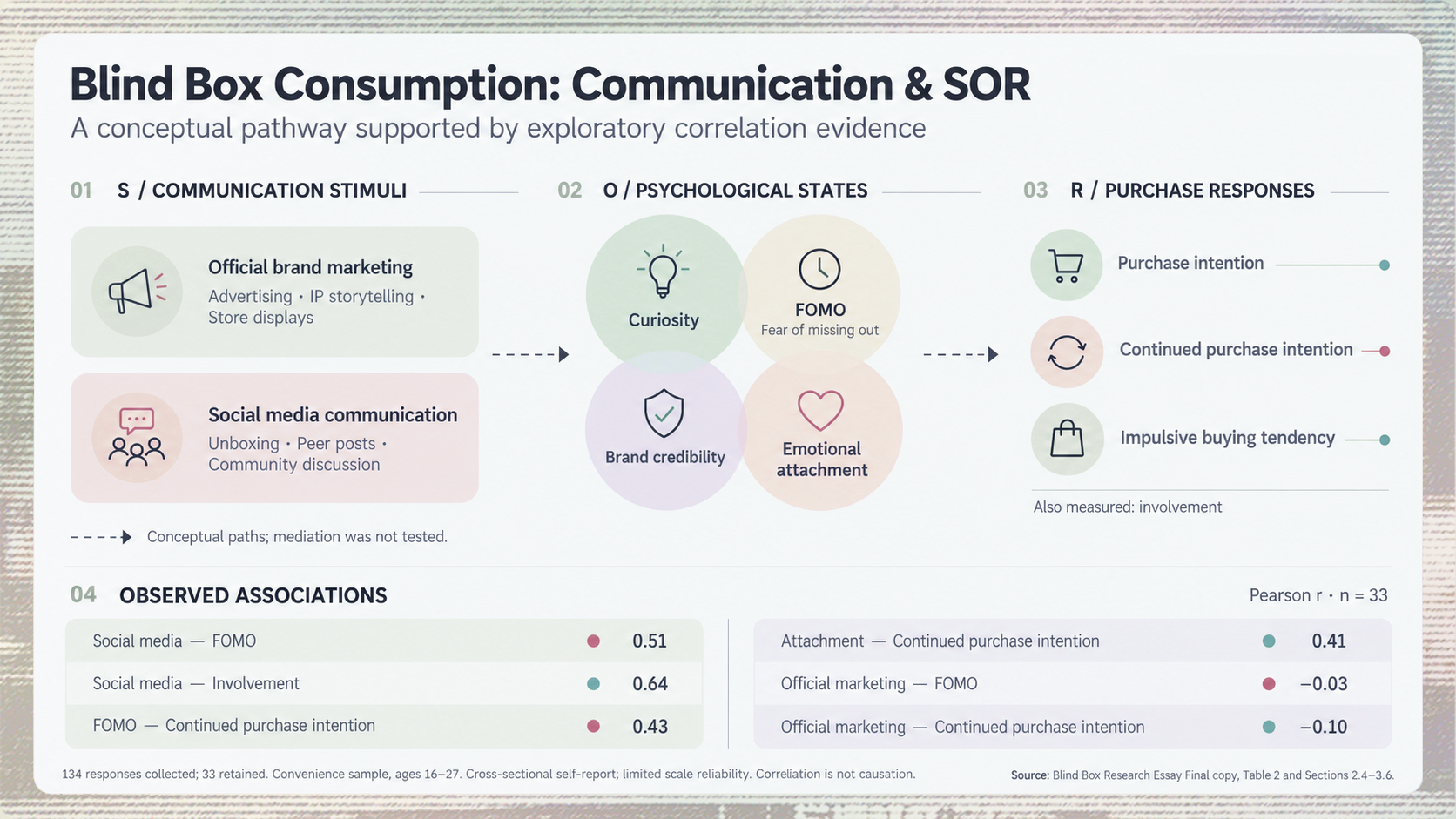
Blind box consumption is often explained through the uncertainty of the product itself: buyers anticipate a surprise, hope for a rare item, and may feel pressure to complete a collection. I wanted to examine a different layer of the experience - the communication environment surrounding the purchase. Using the Stimulus-Organism-Response framework, I compared official brand marketing with social media communication as two forms of external stimulus. I then considered how they relate to internal responses including curiosity, fear of missing out, brand credibility, and emotional attachment before influencing purchase-related behavior. This framework made it possible to ask whether centralized storytelling and fast-moving social content work through the same psychological pathway. The research therefore treated blind box consumption not only as a reaction to chance, but also as a behavior shaped by repeated exposure, social comparison, community participation, and symbolic connection.
Research Design
Building an Exploratory Study with Clear Limits
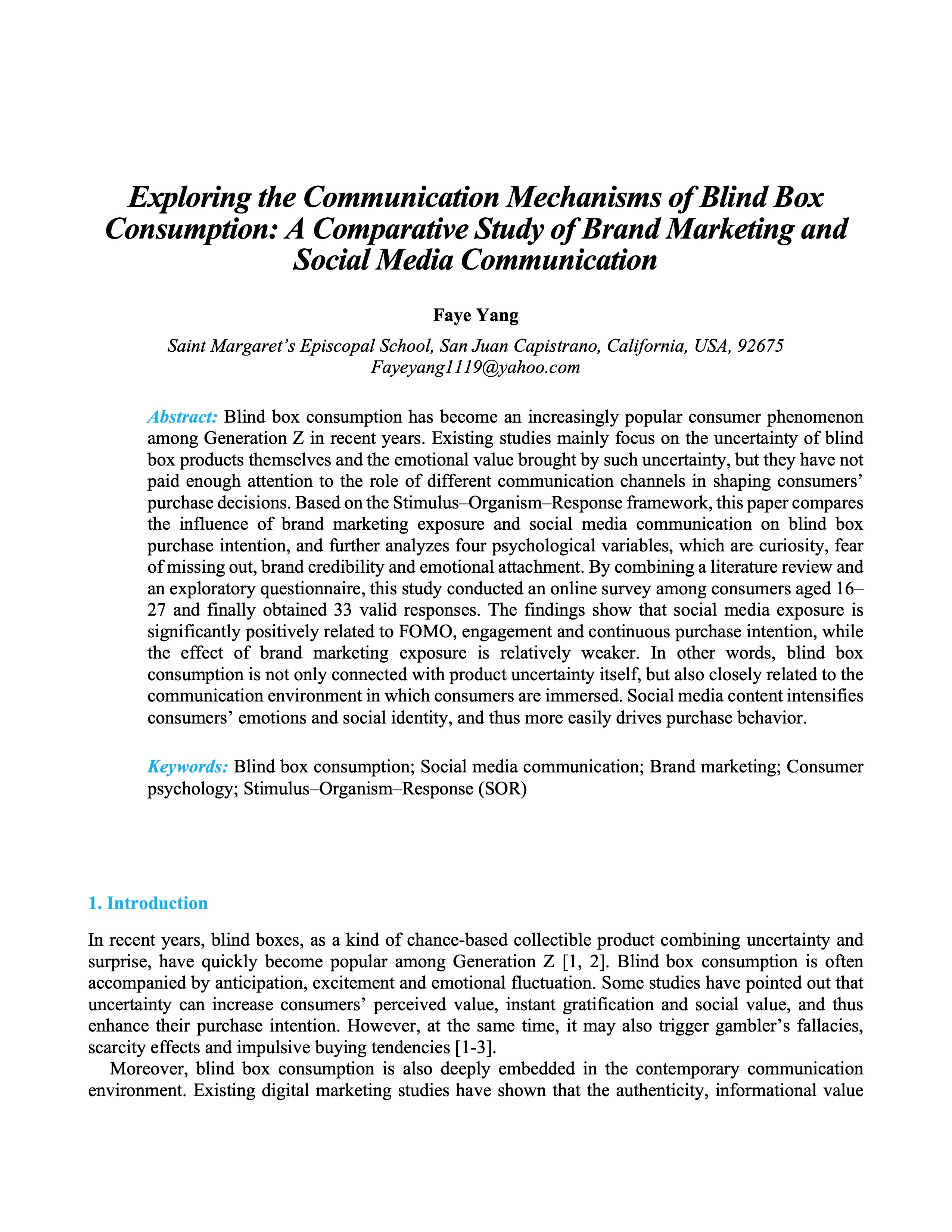
I combined a literature review with an exploratory online questionnaire for Generation Z consumers aged sixteen to twenty-seven. The survey collected 134 responses through convenience sampling on social media. After removing respondents who had not purchased a blind box within the previous six months, fell outside the target age range, or failed the attention check, I retained 33 valid responses. Five-point Likert scales measured exposure to official marketing and social media alongside curiosity, FOMO, brand credibility, emotional attachment, purchase intentions, impulsive tendencies, and involvement. I cleaned and coded the data in Jamovi, calculated descriptive statistics and reliability measures, and used Pearson correlations to identify preliminary relationships. Because the sample was small and several scales had limited internal consistency, I did not conduct regression or mediation analysis and treated every empirical result as exploratory rather than causal.
Click to read the full paper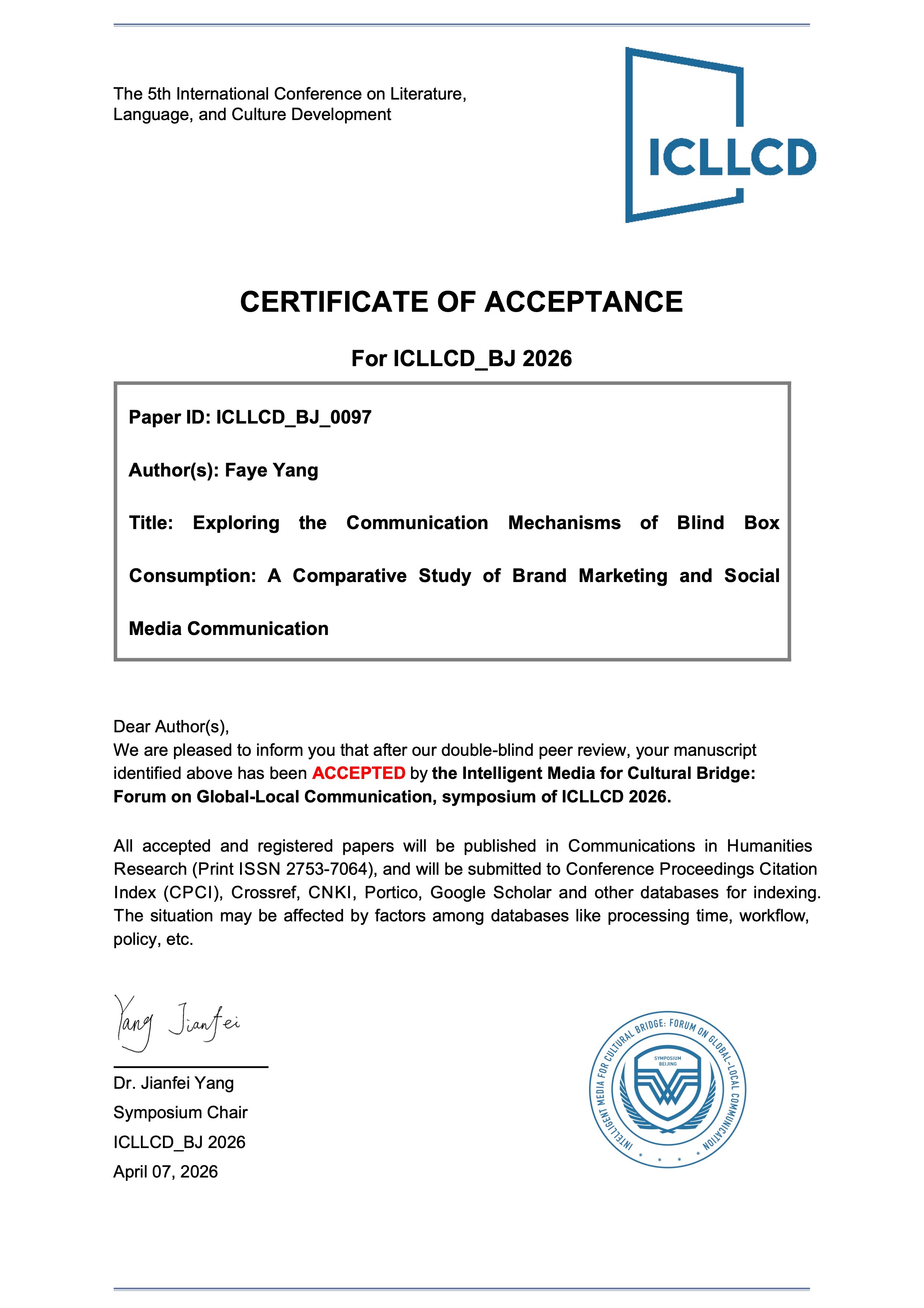
Findings
Social Media Was More Closely Connected to Immediate Engagement
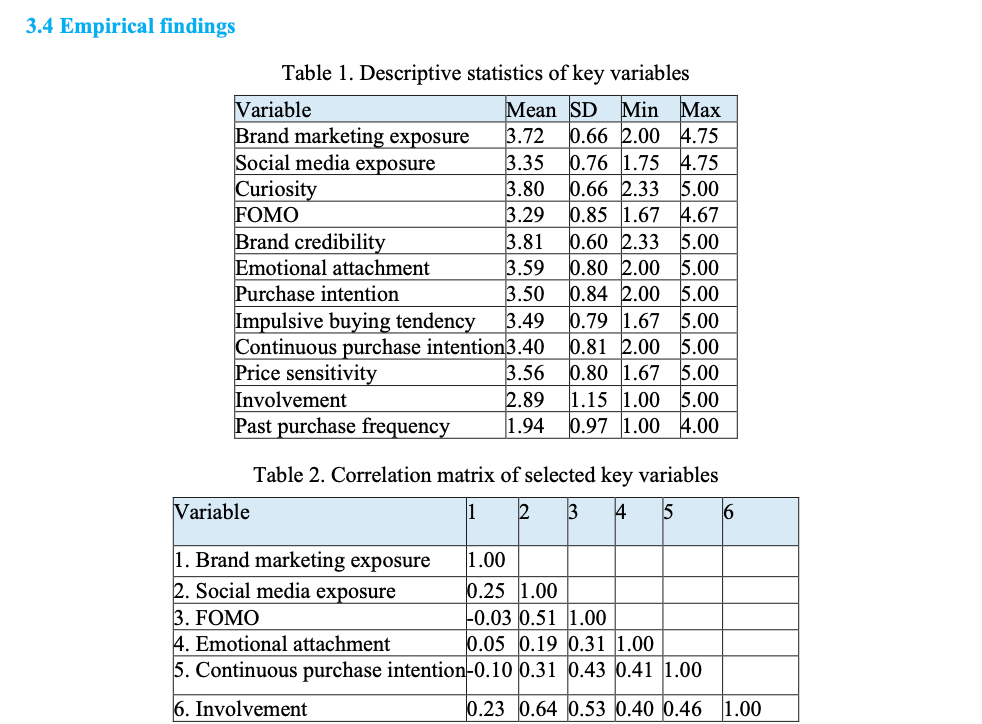
The exploratory results showed different patterns for the two communication channels. Social media exposure was positively related to FOMO (r = 0.51), continuous purchase intention (r = 0.31), and involvement (r = 0.64). FOMO was also related to continuous purchase intention (r = 0.43) and involvement (r = 0.53), suggesting that repeated exposure to unboxing content, limited editions, and peer activity may intensify emotional urgency and participation. Emotional attachment was associated with continued purchase intention (r = 0.41) and involvement (r = 0.40). Official brand marketing, by contrast, showed weak relationships with FOMO and immediate repeat-purchase intention in this sample. I interpreted this difference cautiously: social media may trigger short-term emotion and social comparison more directly, while official storytelling may contribute to familiarity, credibility, and longer-term attachment through a slower process that this small cross-sectional study could not fully measure.
Designing Engagement Without Exploiting Emotional Pressure
The findings suggested that communication channels should not be treated as interchangeable. Official brand content can establish a coherent world, introduce characters, and build trust over time. Social media can make that world participatory through creators, unboxing videos, community discussion, and visible scarcity, but it can also intensify FOMO and impulsive behavior. For consumer brands, the challenge is to create engagement without relying excessively on urgency or social pressure. Clear product information, responsible messaging, and sustainable storytelling can support a longer relationship with customers rather than encouraging repeated purchases only through limited releases. This distinction also matters beyond blind boxes. Any experience-based brand must consider not only what it communicates, but where the message appears, how quickly it circulates, and which emotions the surrounding platform amplifies. Communication is therefore part of the designed customer experience, not merely a promotional layer added after the product.
Limitations & Future Research
Knowing What the Data Could Not Prove
The final sample of 33 respondents was small, predominantly female, and concentrated among younger participants recruited through convenience sampling. Several measures also showed limited reliability, while the cross-sectional, self-reported design could not establish causation. Future research should use a larger and more balanced sample, validated measurement scales, and experimental or longitudinal methods. Comparing countries, platforms, and blind box communities could also test whether the observed communication patterns extend beyond a specific media and cultural environment.
What I Took Away
Treating Caution as Part of Good Research
This project taught me that responsible analysis requires restraint as well as curiosity. Finding a correlation is not the same as proving a cause, and an interesting pattern does not erase weaknesses in sampling or measurement. Cleaning responses, checking reliability, and deciding not to run more advanced models were meaningful research choices. I learned to separate what the evidence suggested from what it could actually support, while still translating the findings into useful questions about digital communication, consumer emotion, and brand responsibility.
Next project

2026 FAYE
BLIND BOX CONSUMPTION
How Communication Channels Shape Emotion and Purchase Behavior
ROLE
Researcher
Sole Author
DURATION
November 2025 – April 2026
FRAMEWORK
Stimulus-Organism-Response (SOR)
OUTCOME
Accepted by the Intelligent Media for Cultural Bridge symposium of ICLLCD 2026
Research Question & Framework
Looking Beyond the Product's Built-In Uncertainty
Blind box consumption is often explained through the uncertainty of the product itself: buyers anticipate a surprise, hope for a rare item, and may feel pressure to complete a collection. I wanted to examine a different layer of the experience - the communication environment surrounding the purchase. Using the Stimulus-Organism-Response framework, I compared official brand marketing with social media communication as two forms of external stimulus. I then considered how they relate to internal responses including curiosity, fear of missing out, brand credibility, and emotional attachment before influencing purchase-related behavior. This framework made it possible to ask whether centralized storytelling and fast-moving social content work through the same psychological pathway. The research therefore treated blind box consumption not only as a reaction to chance, but also as a behavior shaped by repeated exposure, social comparison, community participation, and symbolic connection.
Research Design
Building an Exploratory Study with Clear Limits
I combined a literature review with an exploratory online questionnaire for Generation Z consumers aged sixteen to twenty-seven. The survey collected 134 responses through convenience sampling on social media. After removing respondents who had not purchased a blind box within the previous six months, fell outside the target age range, or failed the attention check, I retained 33 valid responses. Five-point Likert scales measured exposure to official marketing and social media alongside curiosity, FOMO, brand credibility, emotional attachment, purchase intentions, impulsive tendencies, and involvement. I cleaned and coded the data in Jamovi, calculated descriptive statistics and reliability measures, and used Pearson correlations to identify preliminary relationships. Because the sample was small and several scales had limited internal consistency, I did not conduct regression or mediation analysis and treated every empirical result as exploratory rather than causal.
Click to read the full paperFindings
Social Media Was More Closely Connected to Immediate Engagement
The exploratory results showed different patterns for the two communication channels. Social media exposure was positively related to FOMO (r = 0.51), continuous purchase intention (r = 0.31), and involvement (r = 0.64). FOMO was also related to continuous purchase intention (r = 0.43) and involvement (r = 0.53), suggesting that repeated exposure to unboxing content, limited editions, and peer activity may intensify emotional urgency and participation. Emotional attachment was associated with continued purchase intention (r = 0.41) and involvement (r = 0.40). Official brand marketing, by contrast, showed weak relationships with FOMO and immediate repeat-purchase intention in this sample. I interpreted this difference cautiously: social media may trigger short-term emotion and social comparison more directly, while official storytelling may contribute to familiarity, credibility, and longer-term attachment through a slower process that this small cross-sectional study could not fully measure.
Designing Engagement Without Exploiting Emotional Pressure
The findings suggested that communication channels should not be treated as interchangeable. Official brand content can establish a coherent world, introduce characters, and build trust over time. Social media can make that world participatory through creators, unboxing videos, community discussion, and visible scarcity, but it can also intensify FOMO and impulsive behavior. For consumer brands, the challenge is to create engagement without relying excessively on urgency or social pressure. Clear product information, responsible messaging, and sustainable storytelling can support a longer relationship with customers rather than encouraging repeated purchases only through limited releases. This distinction also matters beyond blind boxes. Any experience-based brand must consider not only what it communicates, but where the message appears, how quickly it circulates, and which emotions the surrounding platform amplifies. Communication is therefore part of the designed customer experience, not merely a promotional layer added after the product.
Limitations & Future Research
Knowing What the Data Could Not Prove
The final sample of 33 respondents was small, predominantly female, and concentrated among younger participants recruited through convenience sampling. Several measures also showed limited reliability, while the cross-sectional, self-reported design could not establish causation. Future research should use a larger and more balanced sample, validated measurement scales, and experimental or longitudinal methods. Comparing countries, platforms, and blind box communities could also test whether the observed communication patterns extend beyond a specific media and cultural environment.
What I Took Away
Treating Caution as Part of Good Research
This project taught me that responsible analysis requires restraint as well as curiosity. Finding a correlation is not the same as proving a cause, and an interesting pattern does not erase weaknesses in sampling or measurement. Cleaning responses, checking reliability, and deciding not to run more advanced models were meaningful research choices. I learned to separate what the evidence suggested from what it could actually support, while still translating the findings into useful questions about digital communication, consumer emotion, and brand responsibility.
Next project
2026 FAYE