Cornell Summer Program
Turning customer insight into clearer business decisions
ROLE
Cornell Precollege Student
Duration
Summer 2026
COURSE
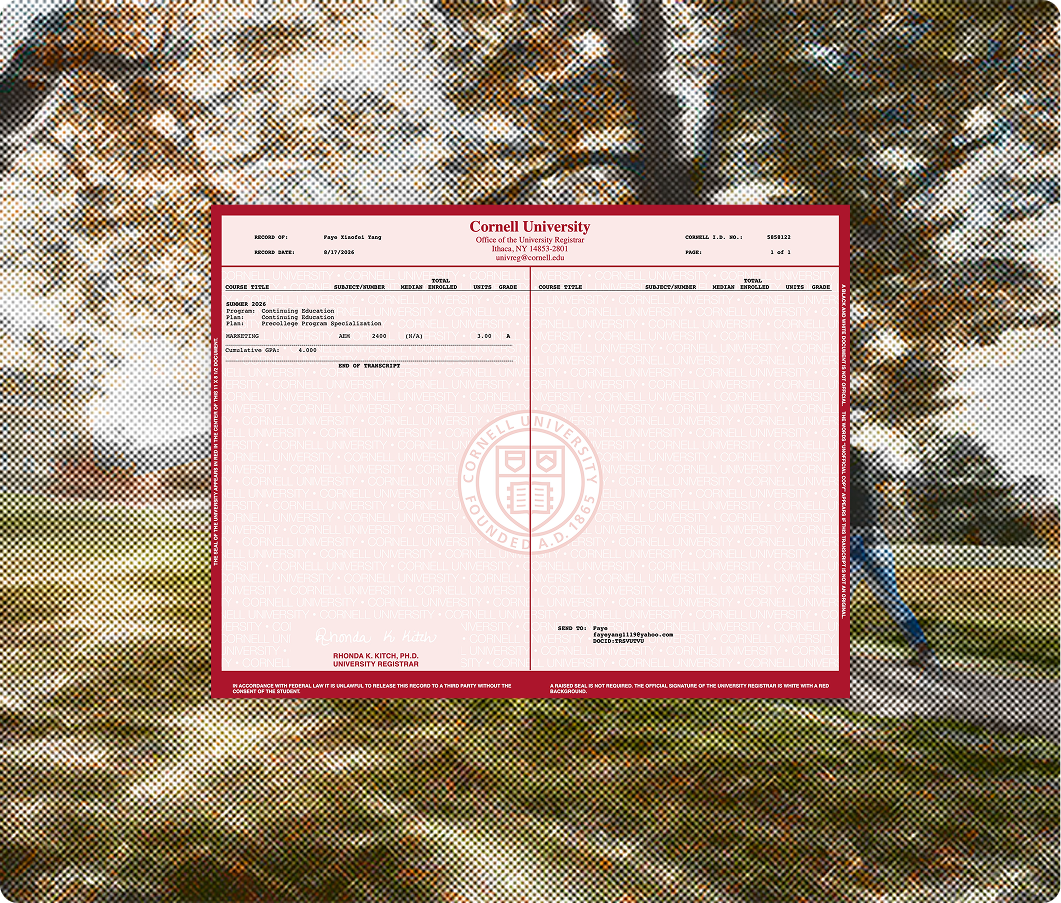
AEM 2400 Marketing
RESULT
Grade A · Cumulative GPA 4.0
Course Foundation
Marketing as a connected system of choices
AEM 2400 provided a broad introduction to marketing as a system of decisions rather than a set of promotional tactics. The course examined how organizations identify target customers, define a position, and coordinate pricing, promotion, and distribution around the value they intend to deliver. Case discussions and field-based applications showed how these choices depend on one another. A strong campaign cannot compensate for a poorly defined audience, and an appealing product can still fail if its price, channel, or message conflicts with customer expectations. I learned to look at marketing from both the customer and organizational perspectives: what problem a customer is trying to solve, how the offer is understood, and whether the company can deliver that promise consistently. This foundation gave me a clearer vocabulary for analyzing brands and a more structured way to move from observation to a marketing decision.
Research & Analysis
Turning information into evidence for a decision
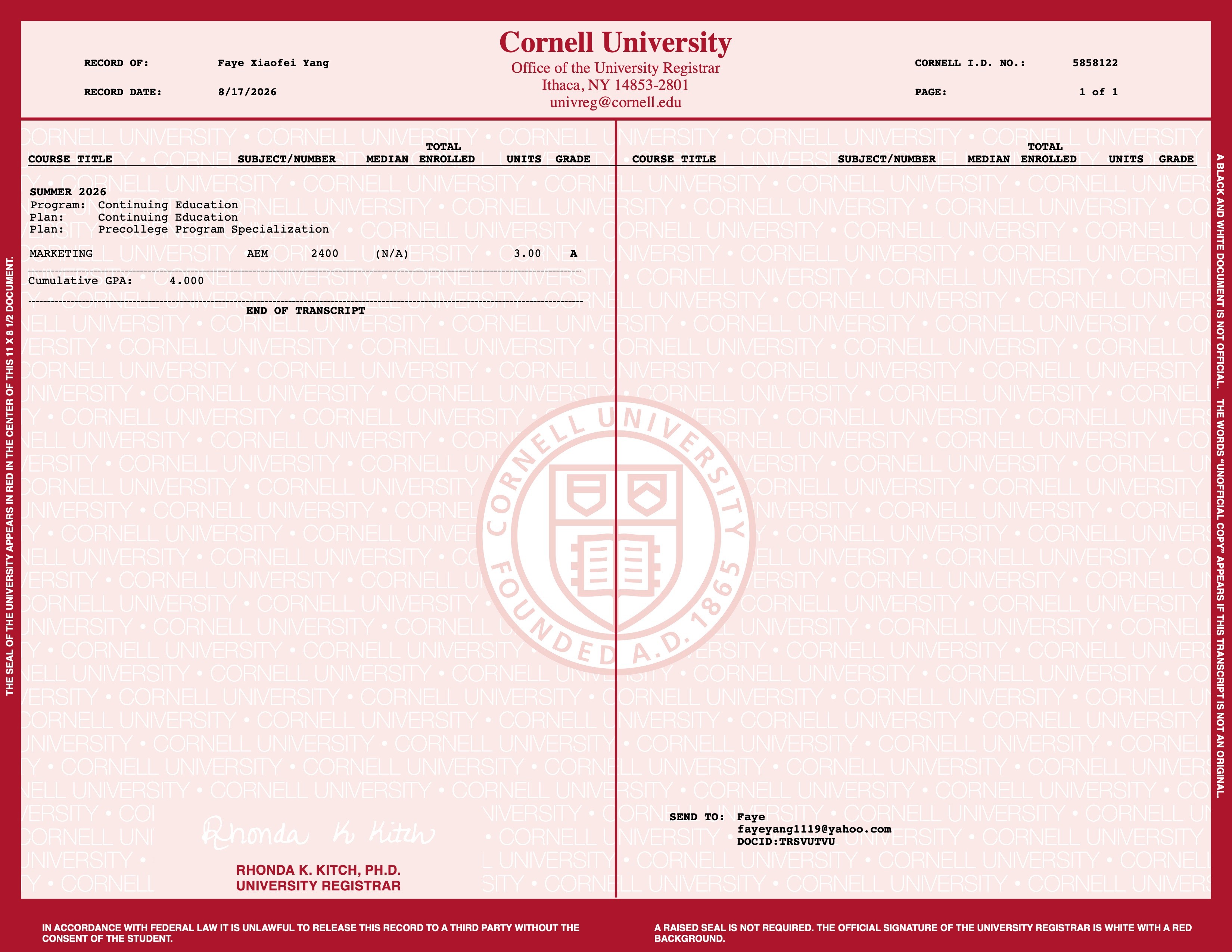
The course also introduced marketing research and the use of qualitative and quantitative tools to examine real managerial questions. I learned that data becomes useful only when it is connected to a well-defined decision. Before collecting information, a marketer needs to know what uncertainty must be reduced: which segment to prioritize, what customers value, why an offer is underperforming, or how a change in price or communication may affect behavior. Case analysis helped me separate evidence from assumption and consider the limits of a conclusion. Numbers can reveal patterns, while interviews and observation can explain why those patterns may exist. Bringing these forms of evidence together made marketing analysis feel both rigorous and human. It reinforced a habit I want to continue developing: asking precise questions, choosing appropriate evidence, and remaining cautious about claims that the available data cannot support.
Hospitality Connection
When a brand promise becomes a guest experience
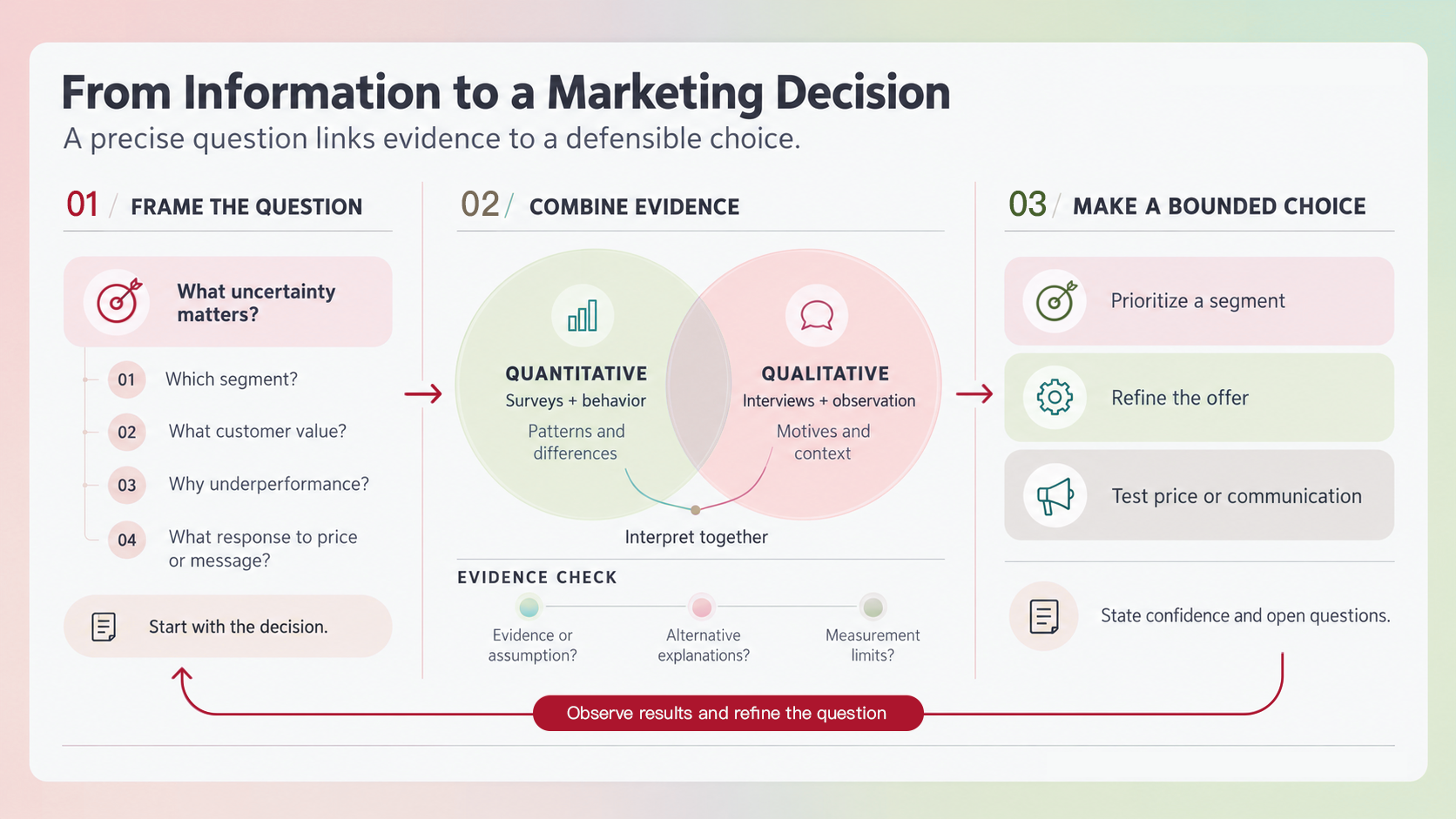
Hospitality made the marketing frameworks especially tangible because a hotel is not only selling a room; it is shaping an experience across many moments. Segmentation can influence which guests a property prioritizes, positioning can define the promise those guests expect, and pricing and distribution can affect how that promise is discovered and evaluated. Promotion must remain consistent with what guests encounter after arrival, from the physical environment to service interactions and digital tools. Applying the course concepts to hospitality helped me see that marketing and operations cannot be separated. A brand promise becomes credible only when the full service system supports it. This perspective also connected the course to my broader interests in hotel technology, sensory branding, and customer experience. It gave me a more complete way to consider how research, positioning, channels, and on-site delivery work together.
Campus Experience
Learning beyond the classroom
Living and studying on Cornell's campus added an important personal dimension to the course. The daily rhythm of classes, independent work, new friendships, and unfamiliar surroundings required me to manage my time and make decisions more independently. Campus life also made learning continue outside the classroom. Conversations with classmates and quiet time reflecting on the day helped me connect academic ideas with different experiences, questions, and perspectives from daily campus life.






What I Took Away
From marketing concepts to better questions
Completing AEM 2400 with an A confirmed the value of consistent preparation, careful analysis, and active engagement. More importantly, the course changed how I approach business questions. I now begin by defining the customer, the decision, and the evidence required before recommending an action. Marketing became a framework for understanding how organizations create, communicate, and deliver value. That framework will continue to guide how I study service businesses and develop projects of my own.
Next project

2026 FAYE
Cornell Summer Program
Turning customer insight into clearer business decisions
ROLE
Cornell Precollege Student
Duration
Summer 2026
COURSE
AEM 2400 Marketing
RESULT
Grade A · Cumulative GPA 4.0
Course Foundation
Marketing as a connected system of choices
AEM 2400 provided a broad introduction to marketing as a system of decisions rather than a set of promotional tactics. The course examined how organizations identify target customers, define a position, and coordinate pricing, promotion, and distribution around the value they intend to deliver. Case discussions and field-based applications showed how these choices depend on one another. A strong campaign cannot compensate for a poorly defined audience, and an appealing product can still fail if its price, channel, or message conflicts with customer expectations. I learned to look at marketing from both the customer and organizational perspectives: what problem a customer is trying to solve, how the offer is understood, and whether the company can deliver that promise consistently. This foundation gave me a clearer vocabulary for analyzing brands and a more structured way to move from observation to a marketing decision.
Research & Analysis
Turning information into evidence for a decision
The course also introduced marketing research and the use of qualitative and quantitative tools to examine real managerial questions. I learned that data becomes useful only when it is connected to a well-defined decision. Before collecting information, a marketer needs to know what uncertainty must be reduced: which segment to prioritize, what customers value, why an offer is underperforming, or how a change in price or communication may affect behavior. Case analysis helped me separate evidence from assumption and consider the limits of a conclusion. Numbers can reveal patterns, while interviews and observation can explain why those patterns may exist. Bringing these forms of evidence together made marketing analysis feel both rigorous and human. It reinforced a habit I want to continue developing: asking precise questions, choosing appropriate evidence, and remaining cautious about claims that the available data cannot support.
Hospitality Connection
When a brand promise becomes a guest experience
Hospitality made the marketing frameworks especially tangible because a hotel is not only selling a room; it is shaping an experience across many moments. Segmentation can influence which guests a property prioritizes, positioning can define the promise those guests expect, and pricing and distribution can affect how that promise is discovered and evaluated. Promotion must remain consistent with what guests encounter after arrival, from the physical environment to service interactions and digital tools. Applying the course concepts to hospitality helped me see that marketing and operations cannot be separated. A brand promise becomes credible only when the full service system supports it. This perspective also connected the course to my broader interests in hotel technology, sensory branding, and customer experience. It gave me a more complete way to consider how research, positioning, channels, and on-site delivery work together.
Campus Experience
Learning beyond the classroom
Living and studying on Cornell's campus added an important personal dimension to the course. The daily rhythm of classes, independent work, new friendships, and unfamiliar surroundings required me to manage my time and make decisions more independently. Campus life also made learning continue outside the classroom. Conversations with classmates and quiet time reflecting on the day helped me connect academic ideas with different experiences, questions, and perspectives from daily campus life.
What I Took Away
From marketing concepts to better questions
Completing AEM 2400 with an A confirmed the value of consistent preparation, careful analysis, and active engagement. More importantly, the course changed how I approach business questions. I now begin by defining the customer, the decision, and the evidence required before recommending an action. Marketing became a framework for understanding how organizations create, communicate, and deliver value. That framework will continue to guide how I study service businesses and develop projects of my own.
Next project
2026 FAYE