HOMTEL
Unlock your 100% home-like hotel experience
ROLE
Independent Product Research
UX/UI Design, 3D Modeling
iOS Development, App Store Launch
Duration
September 2024 – April 2026
PARTNER
Renaissance Hotel
Origin Story
From a hotel stay to HOMTEL
HOMTEL began with a simple observation: a hotel may offer many amenities, yet guests can still struggle to find, understand, and use them. During a stay at Renaissance Hotel, I noticed how easily small information gaps could interrupt an otherwise comfortable experience—from locating activity spaces to understanding room amenities, dining options, and facility availability.
I began the project in September 2024 with the goal of making the hotel environment easier to understand and navigate. Renaissance Hotel supported the project by providing property information and floor plans. Using those materials as a real-world foundation, I independently carried the project from research and spatial modeling to interface design, development, and release.
HOMTEL was created as my personal project. The hotel contributed essential contextual materials, while I was responsible for the product research, concept development, 3D modeling, UX/UI design, technical implementation, and App Store launch.
CHALLENGE
The guest experience problem
Since HOMTEL was the first app I developed entirely on my own—from concept to design to implementation—it was a completely new experience for me. Throughout the process, I came to realize that each stage, from conceptual thinking to interface design and then to actual coding, involves unexpected gaps that require careful integration and adjustment.
For example, while the initial concept focused on specific features or ideas, the app design phase required me to translate those into a seamless and continuous user journey. Every button, every transition demanded a deeper level of detail and refinement based on the original concept, ensuring everything fits within a coherent and functional system.
How might we help hotel guests understand and use unfamiliar spaces, amenities, and services with greater confidence?
Research
Understanding the hotel experience
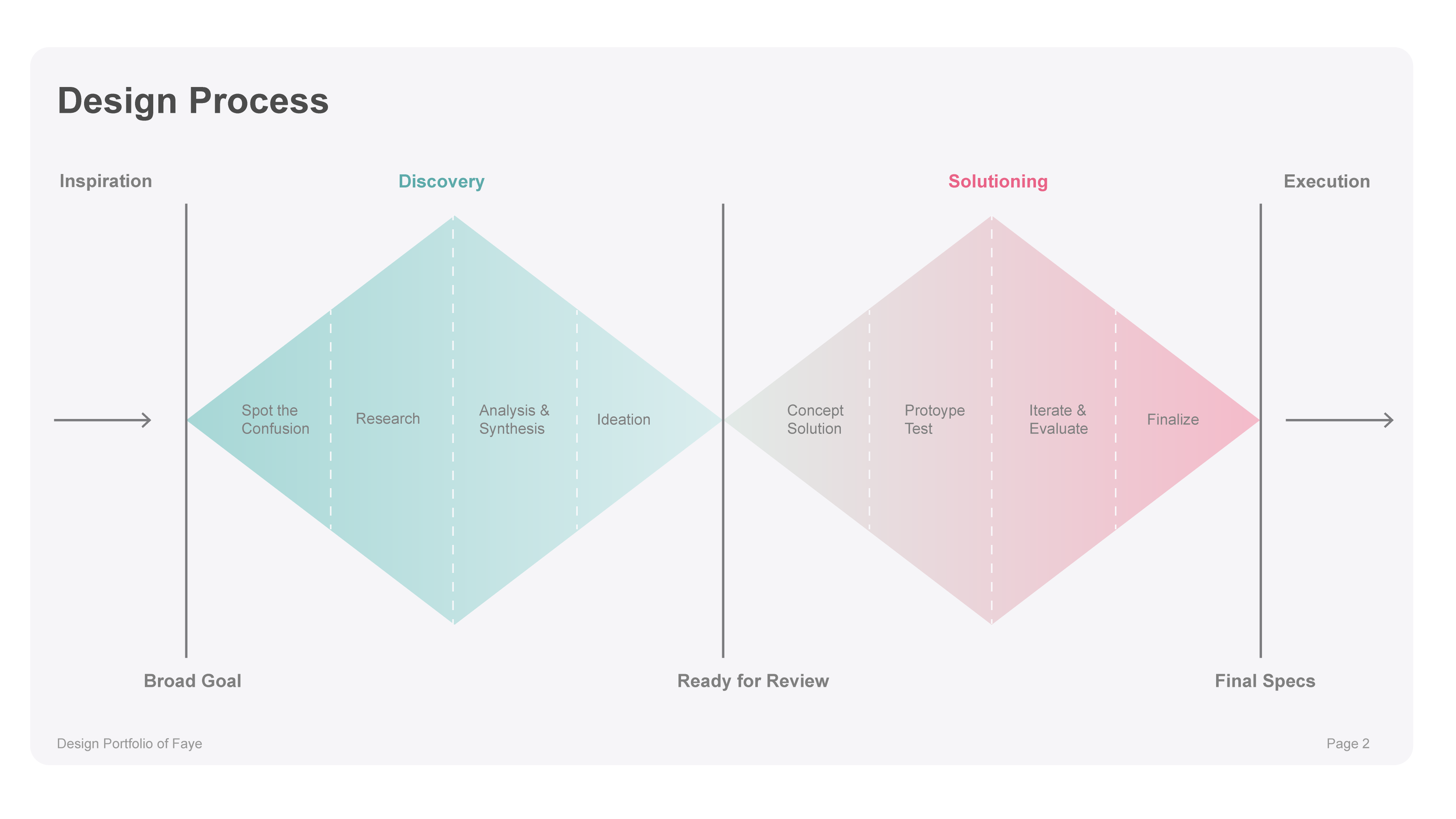
The project moved from inspiration and discovery to analysis, ideation, prototyping, and execution. Each phase helped turn a broad observation into a product grounded in guest needs and a real hotel environment.
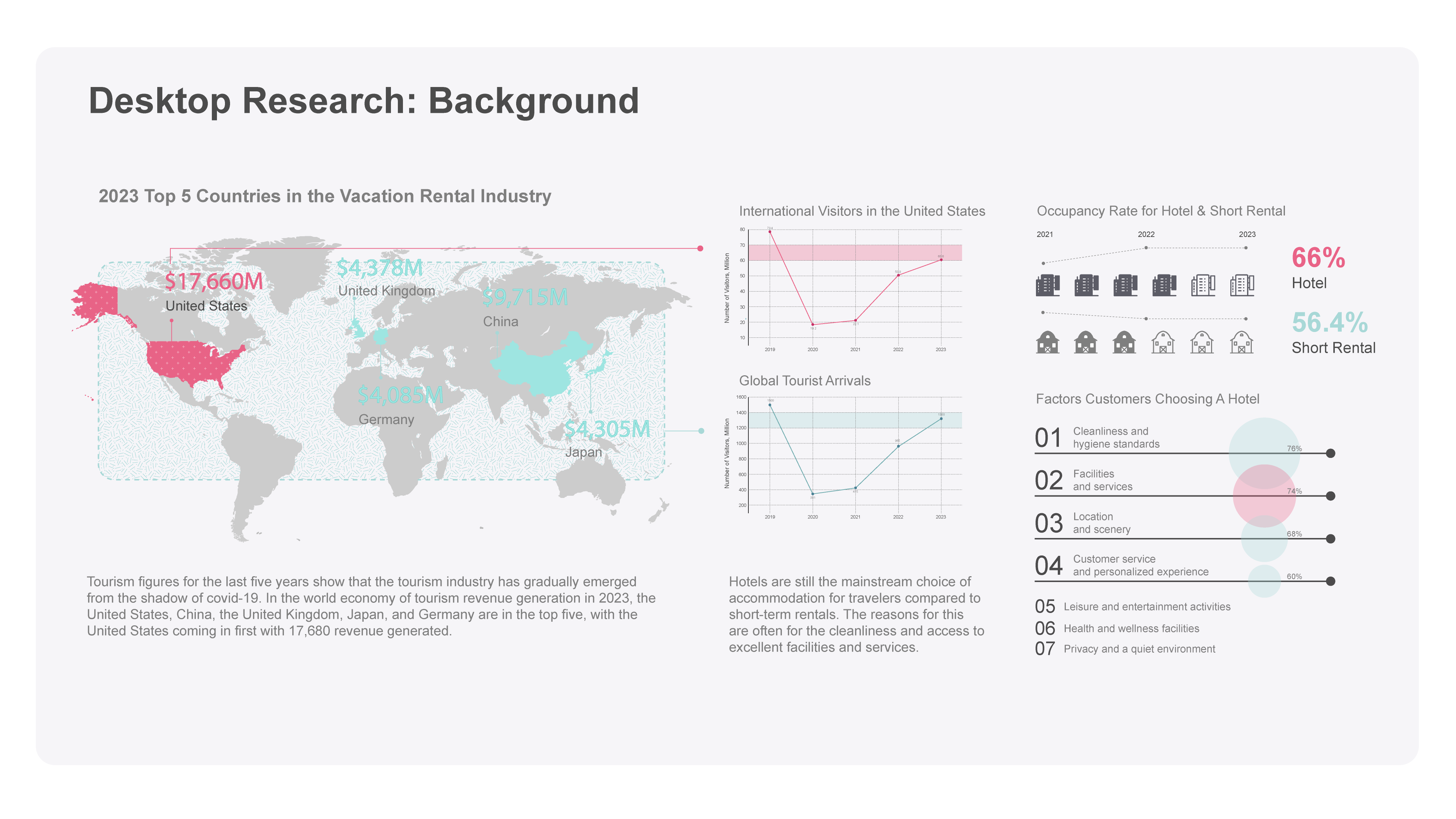
The recovery of travel and the continued importance of hotels highlighted the value guests place on cleanliness, facilities, service quality, location, and personalized experiences. These factors showed that a hotel stay is shaped not only by the room itself, but by how easily guests can understand and access the full service environment.
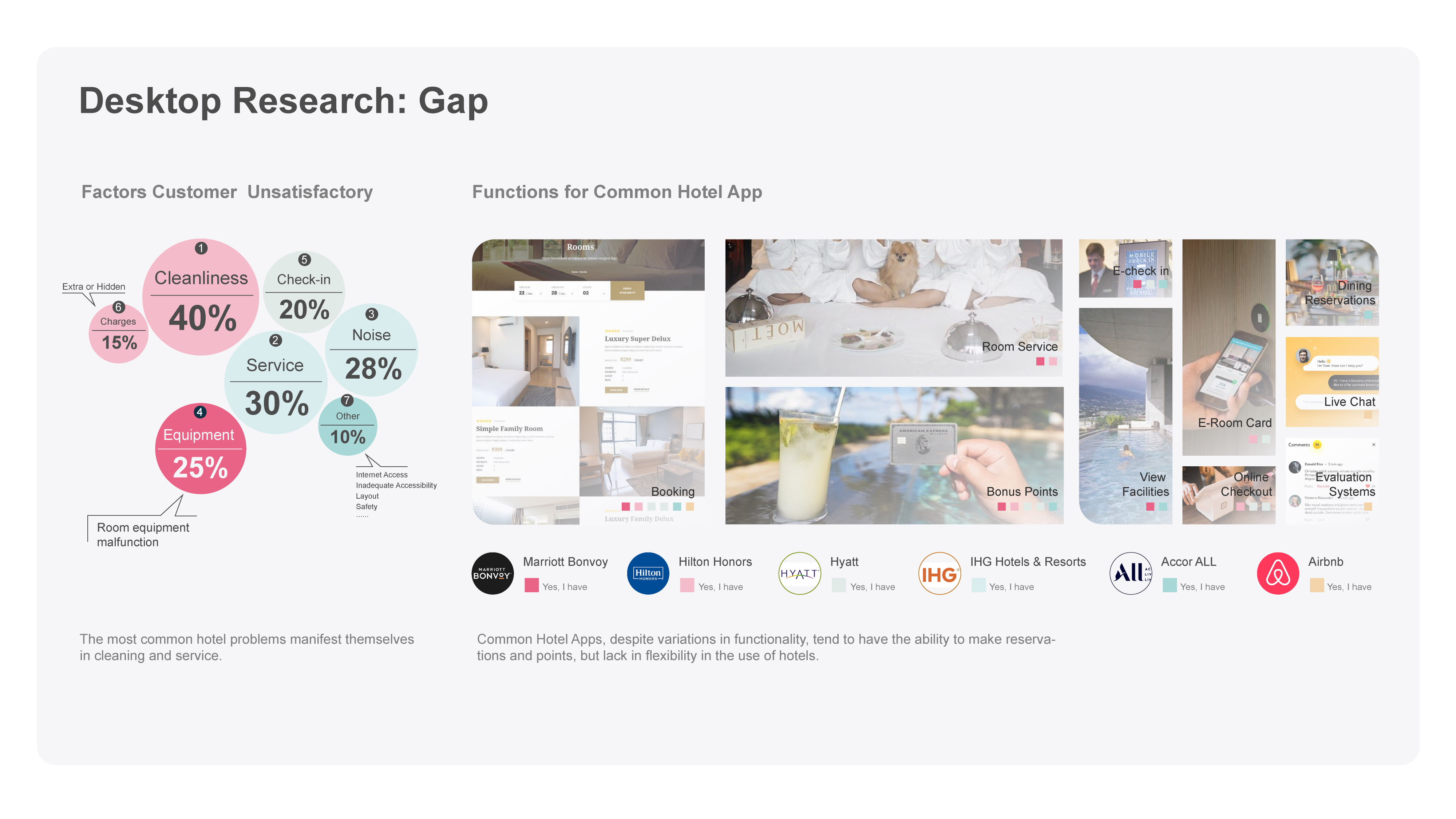
Existing hotel apps were effective at booking, loyalty management, check-in, and room service, but often provided limited support once guests entered the physical hotel environment. Information about exact locations, facility conditions, room equipment, and space availability remained difficult to access.
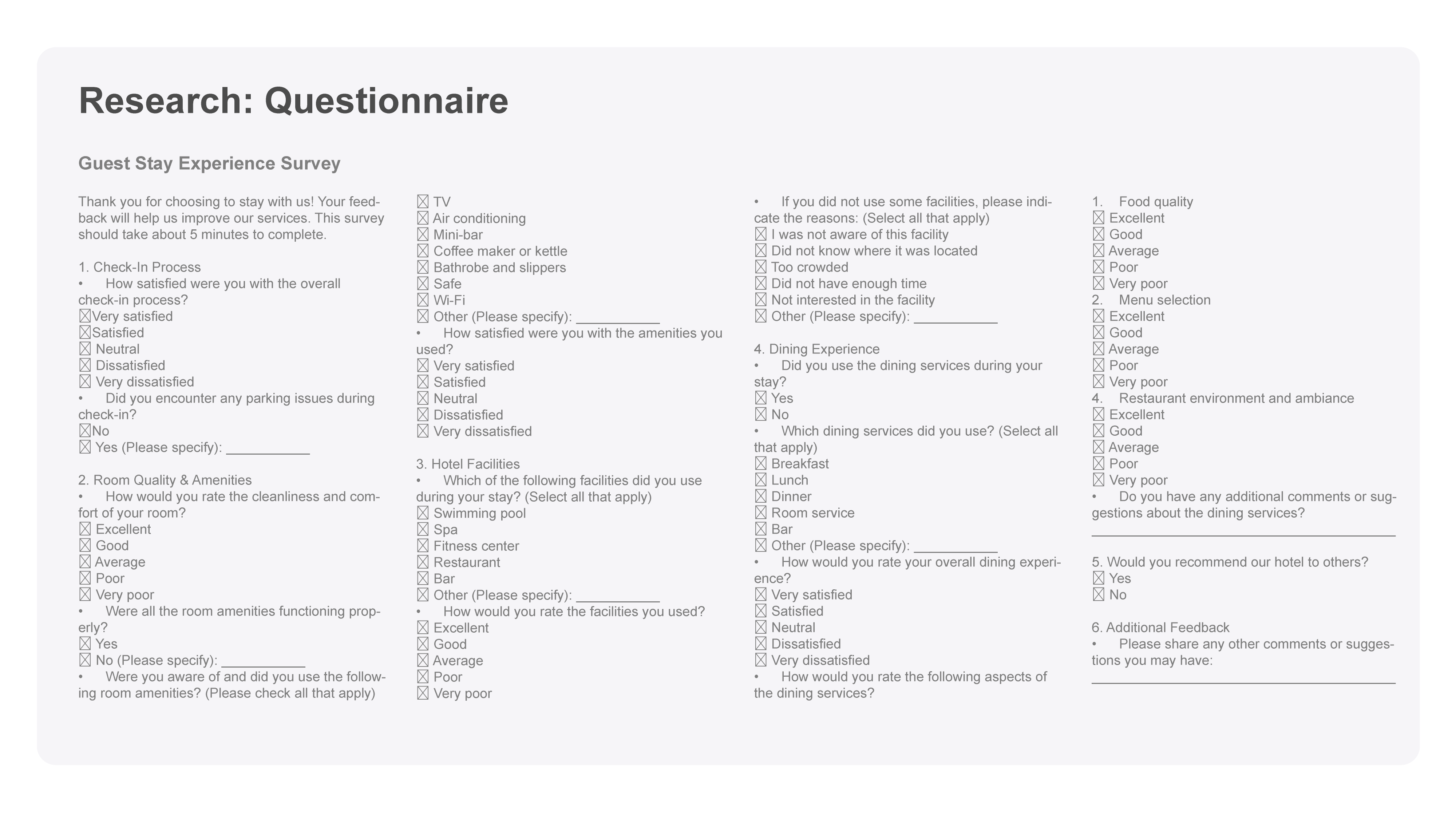
The guest stay experience questionnaire examined check-in, room quality, amenities, hotel facilities, dining, and overall satisfaction. It also asked why guests chose not to use certain facilities, including lack of awareness, unclear locations, crowding, and limited time.
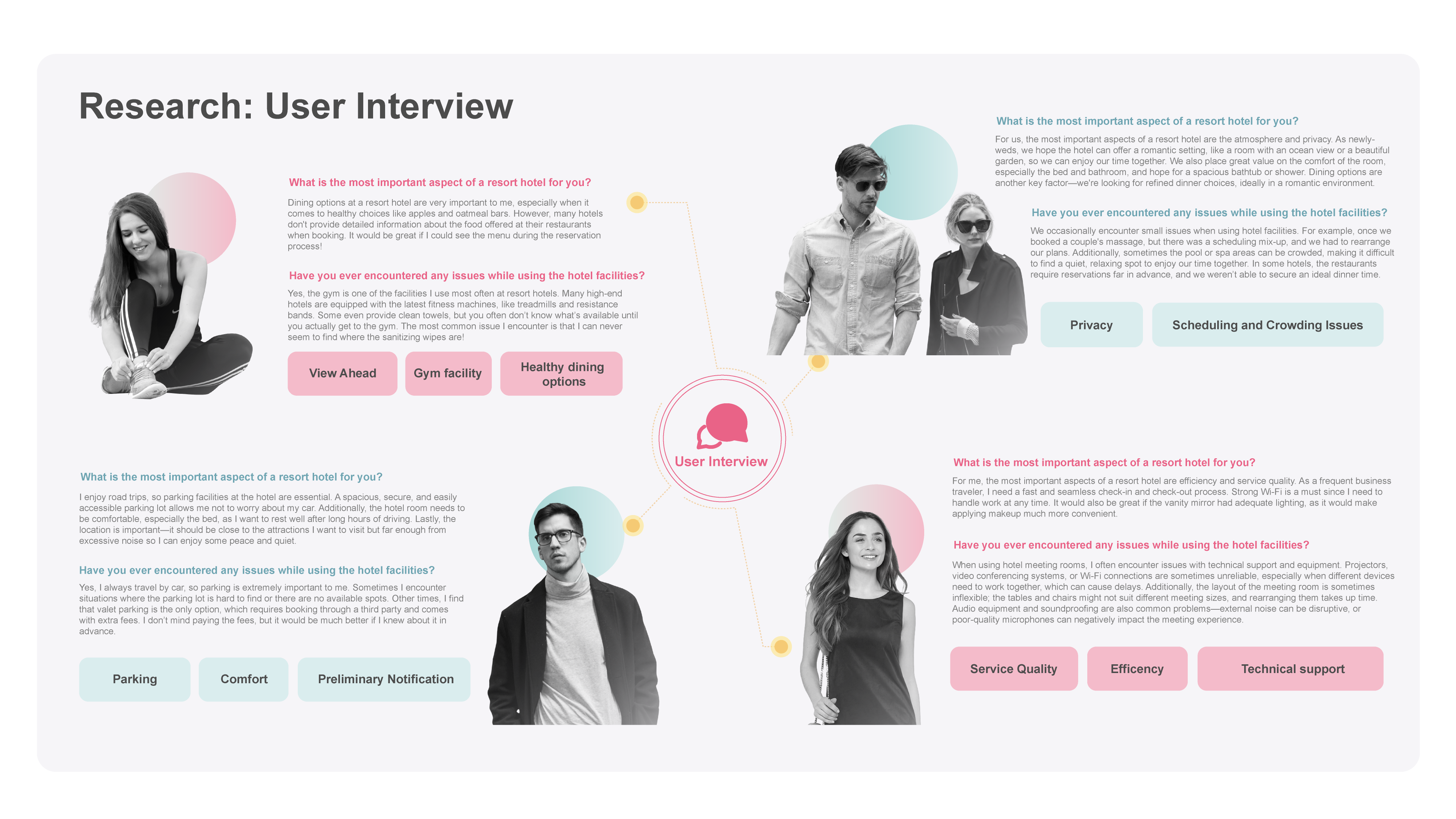
The interviews revealed different priorities across leisure, business, and resort travel. Guests wanted to preview spaces and dining options, understand facility availability, reduce scheduling uncertainty, locate parking and equipment, and receive more reliable service information.
The research showed that guest frustration often came not from the absence of services, but from the absence of timely and accessible information about those services.
Key Insights
Information is part of the service
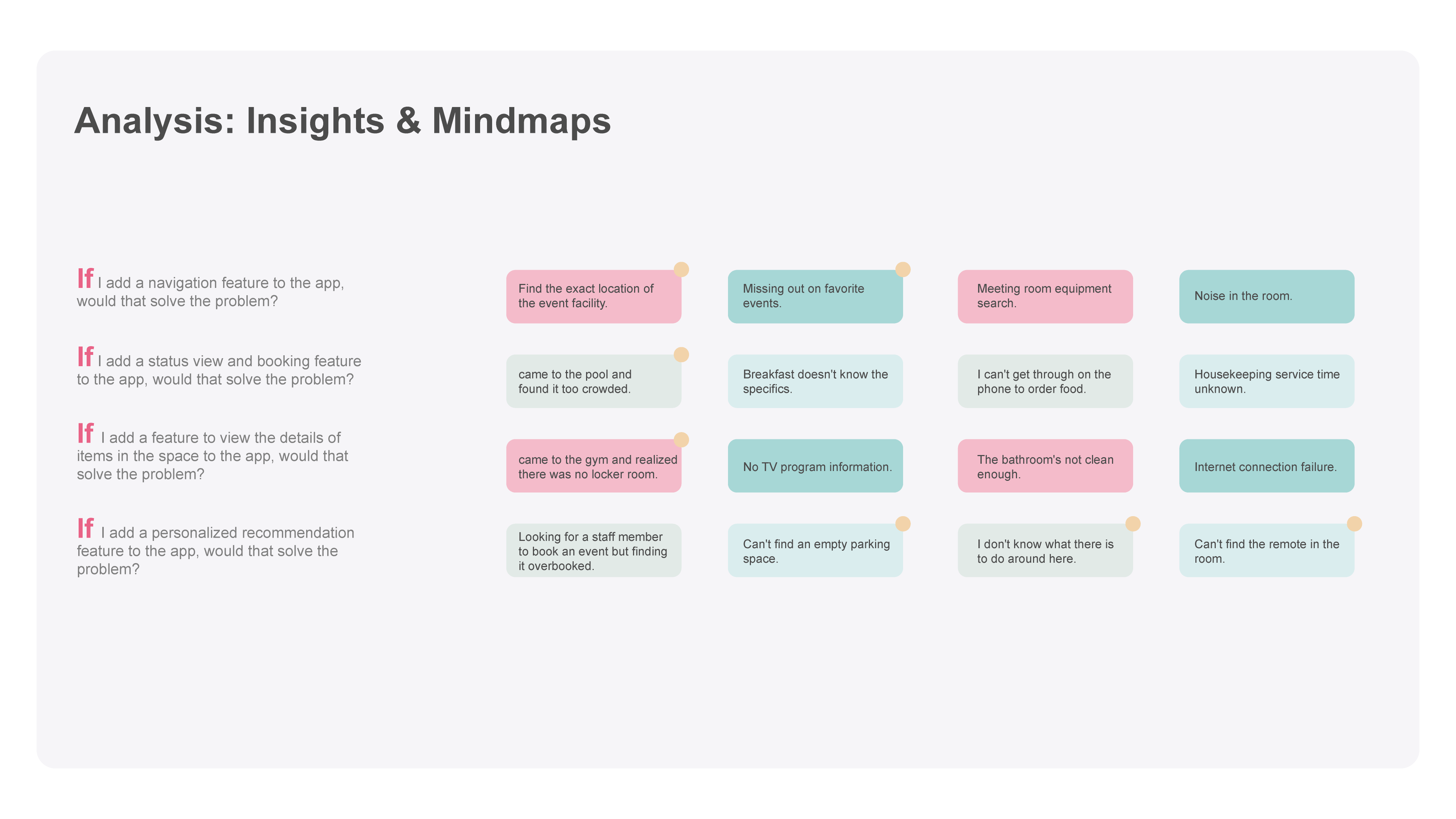
Guests need clear guidance when moving through an unfamiliar hotel environment. Facility status and availability affect how guests plan their time and whether they choose to use a service. Room amenities, shared equipment, and useful items should be easier to identify before guests need them. Dining information is most useful before a guest makes a decision, not after arriving at the restaurant. A digital product should support hotel service by making information more visible and decisions easier—not by removing the human side of hospitality.
Guest Journey
Connecting the moments of a stay
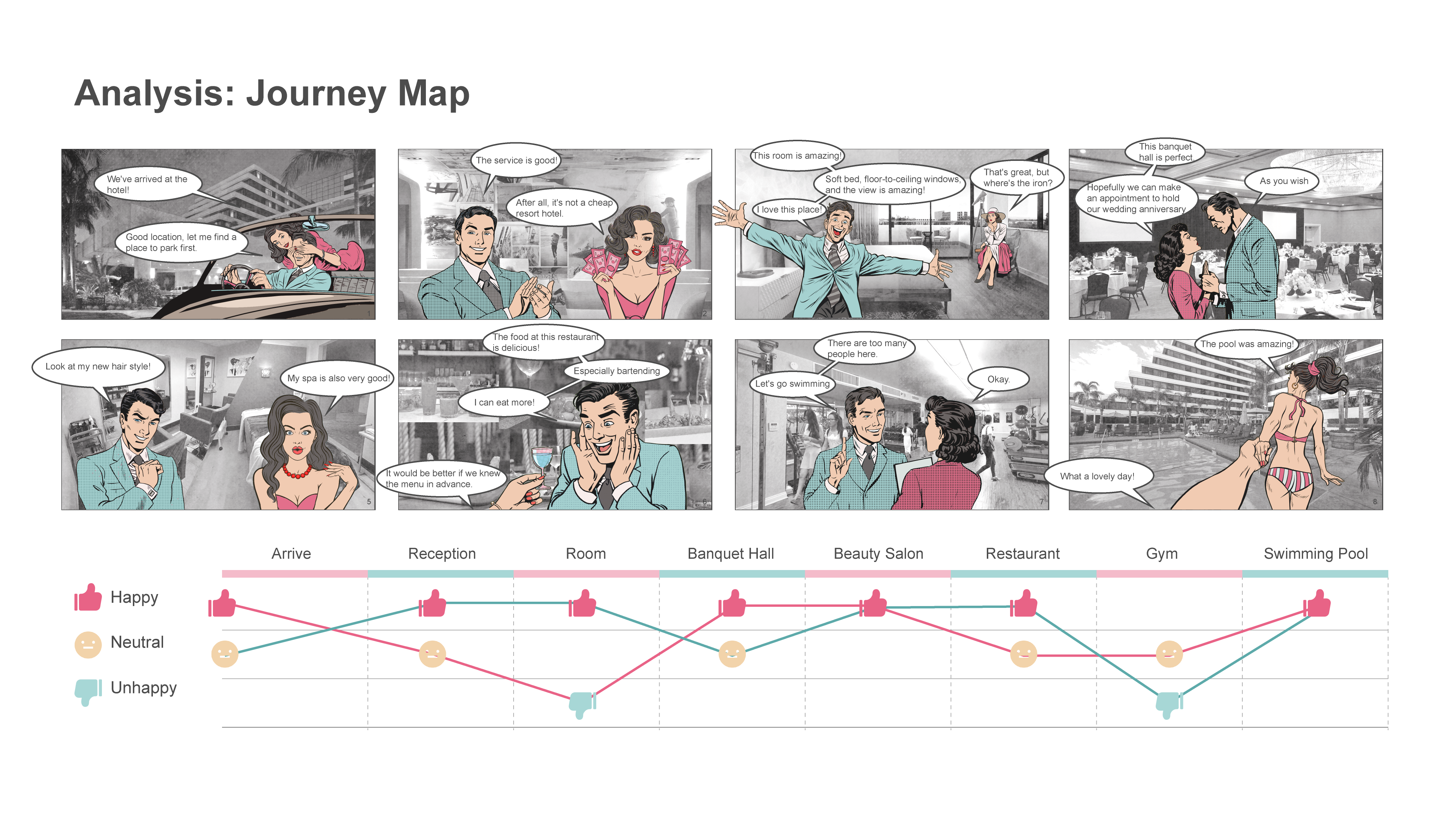
The guest journey extends beyond arrival and check-in. It continues through the room, dining, events, wellness spaces, and every decision a guest makes throughout the stay. Mapping these moments revealed where emotional highs could be interrupted by missing information or unexpected conditions.
The journey map identified three recurring opportunities: helping guests understand spaces, helping them plan ahead, and helping them act without unnecessary friction.
Product Strategy
Freedom, clarity, and flexibility
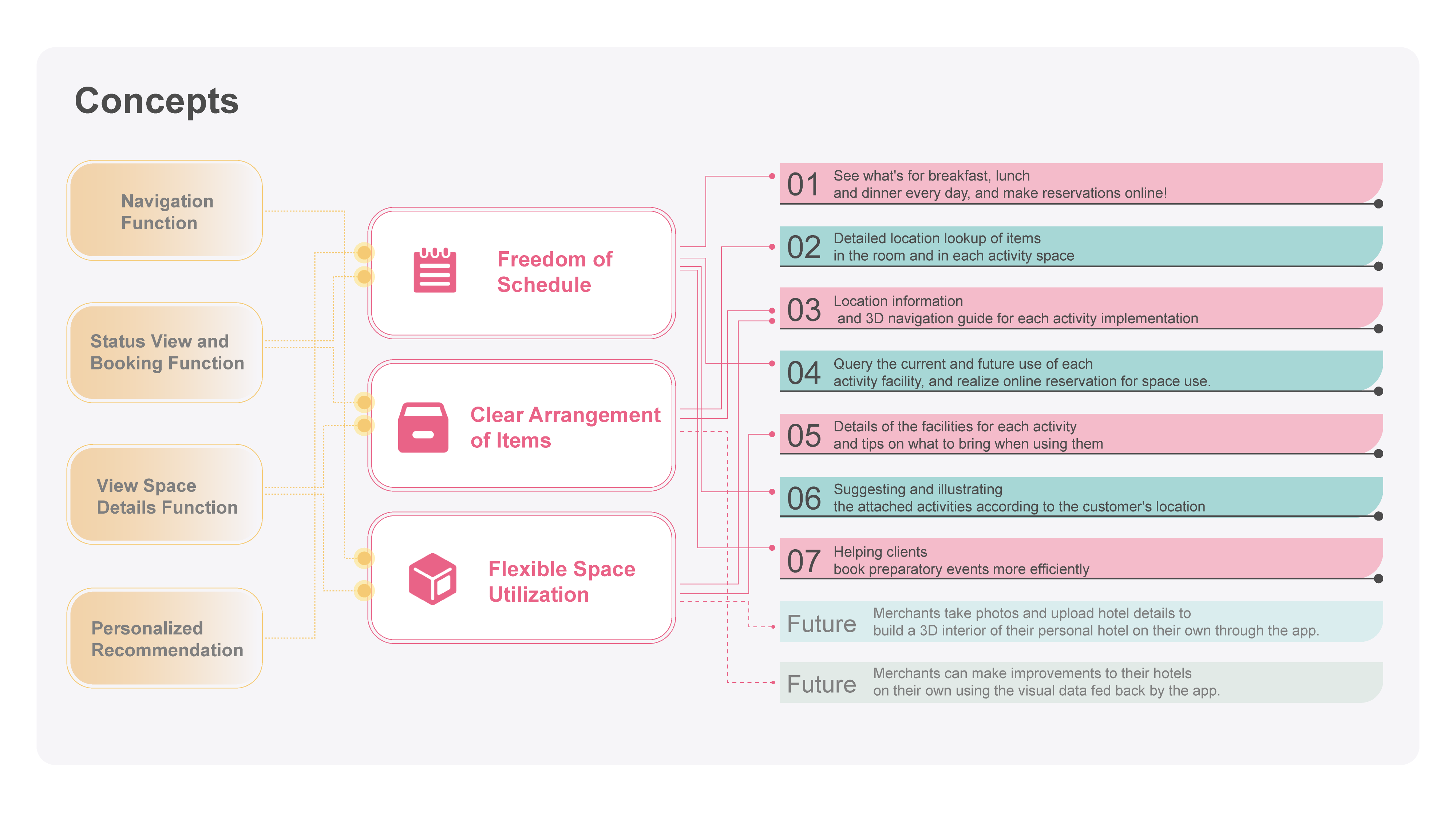
HOMTEL was designed around three principles: freedom of schedule, clear arrangement of items, and flexible use of hotel spaces. Together, these principles connect guest decisions with the physical environment of the hotel.
Guests can review dining, activities, and facility availability before deciding where to go and when to go. Guests can identify room amenities, equipment, and useful items through visual, location-based information. Guests can understand and reserve hotel spaces for dining, fitness, meetings, and events through one connected experience.
Information Architecture & User Flow
A digital layer for the hotel
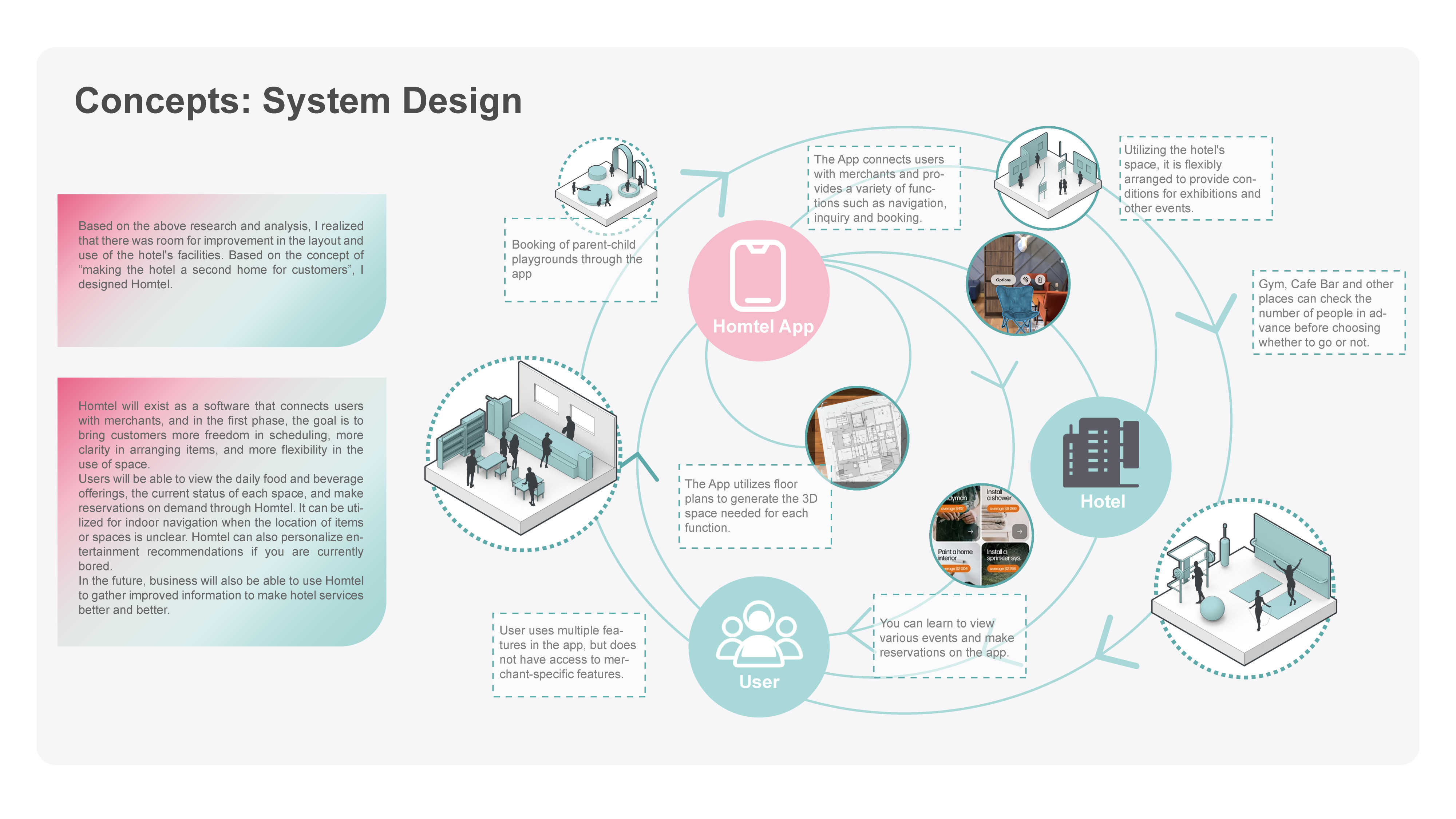
Using hotel information and floor plans supplied by Renaissance Hotel, I translated physical spaces into a digital structure that connects guests with rooms, amenities, restaurants, equipment, activities, and reservable facilities.
The app begins with the hotel environment rather than a list of isolated services. Guests can move from a 3D space to a real-scene view, inspect nearby items, check facility status, browse dining options, and complete reservations.
This structure allows the digital experience to follow the way guests actually move through the hotel: from space, to information, to decision, to action.
Design Development
From floor plans to an interface
The hotel floor plans became the foundation for spatial modeling. I reconstructed key rooms and public areas, organized their functions, and connected each space with the services and information guests would need there.
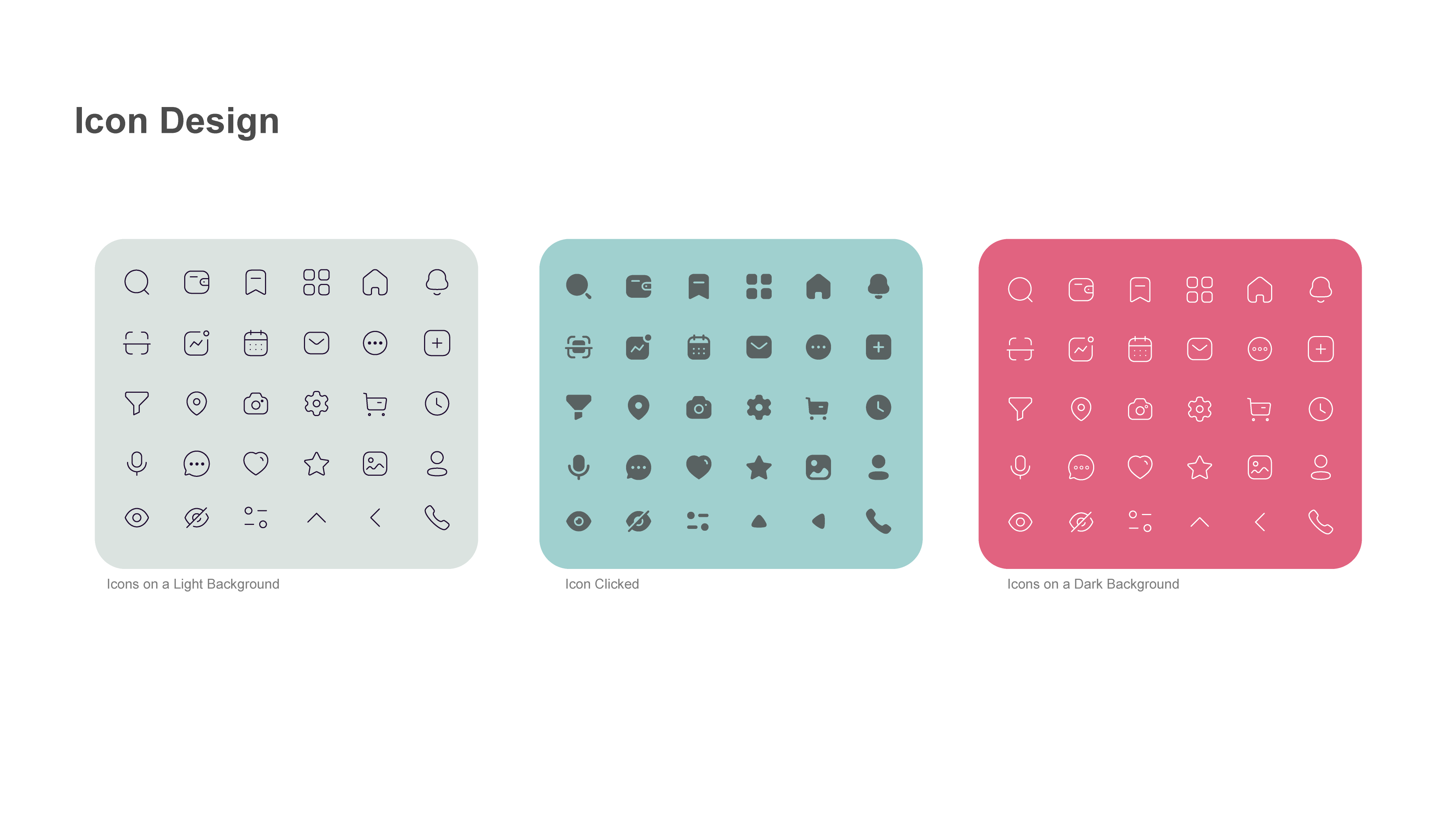
The interface uses a soft pink and teal palette to distinguish areas, guide interaction, and create a sense of comfort. A consistent icon system supports search, location, booking, status, messaging, and personal account actions across the app.
From Space to Service
Real-scene view & room amenities
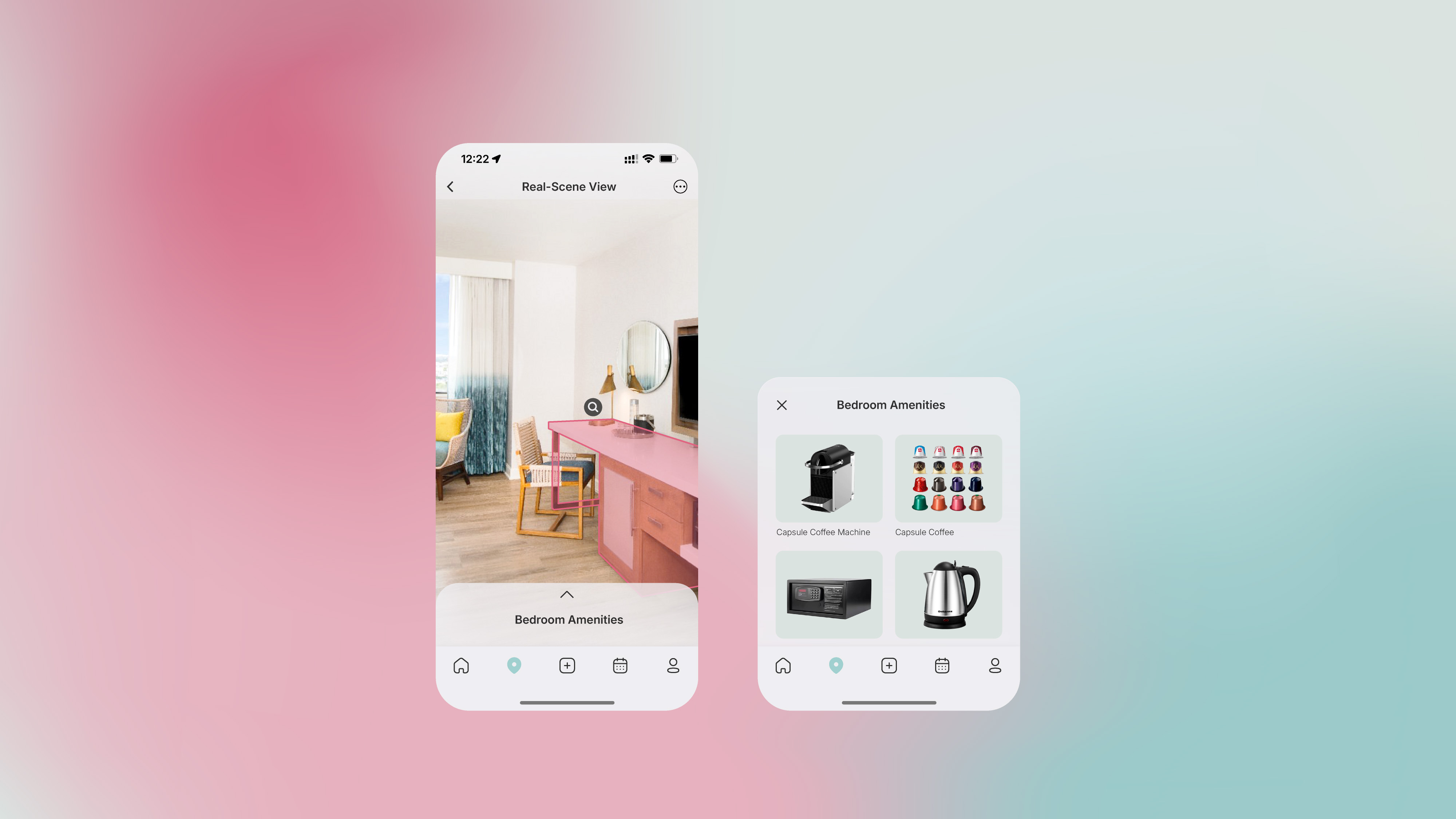
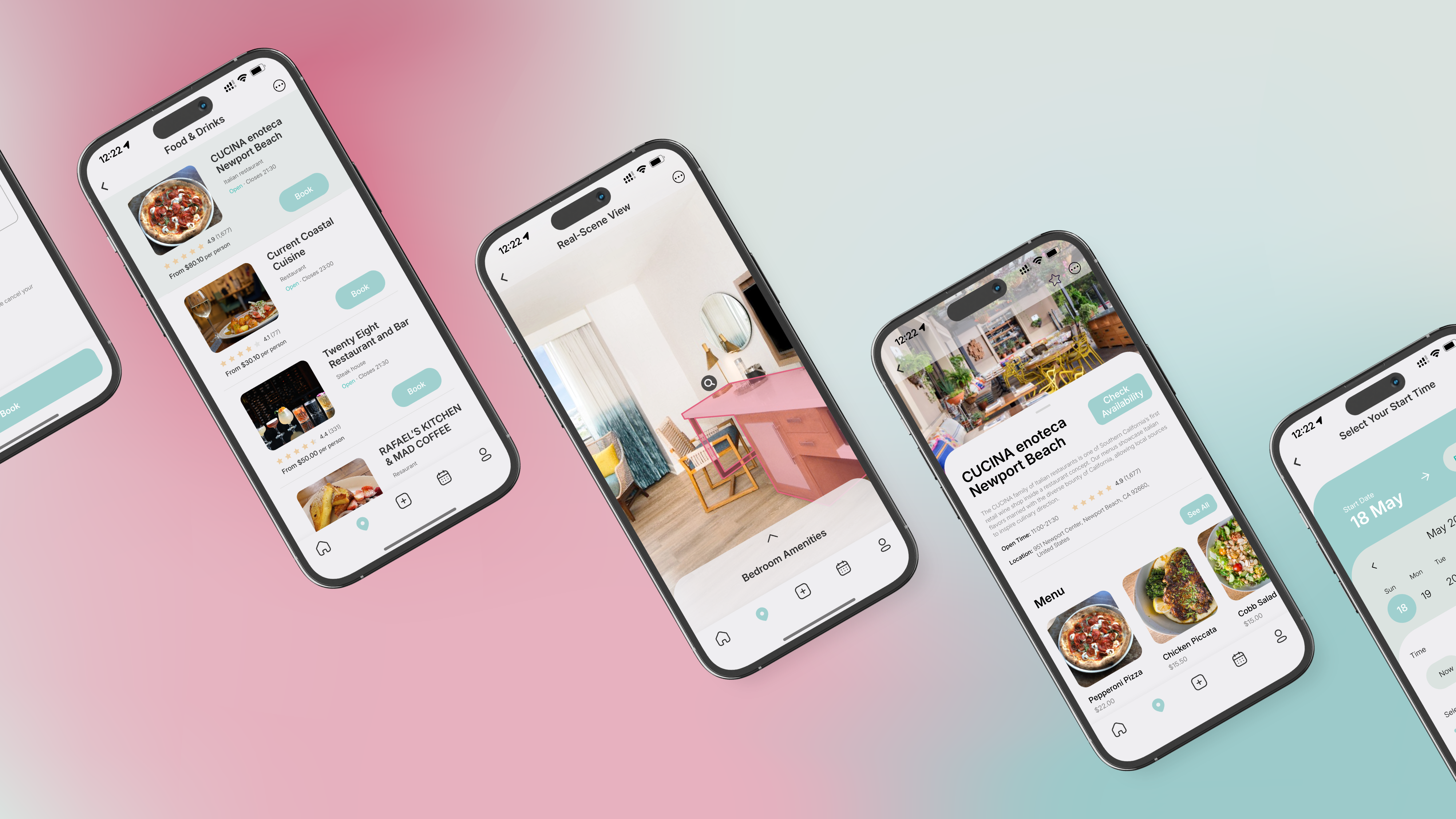
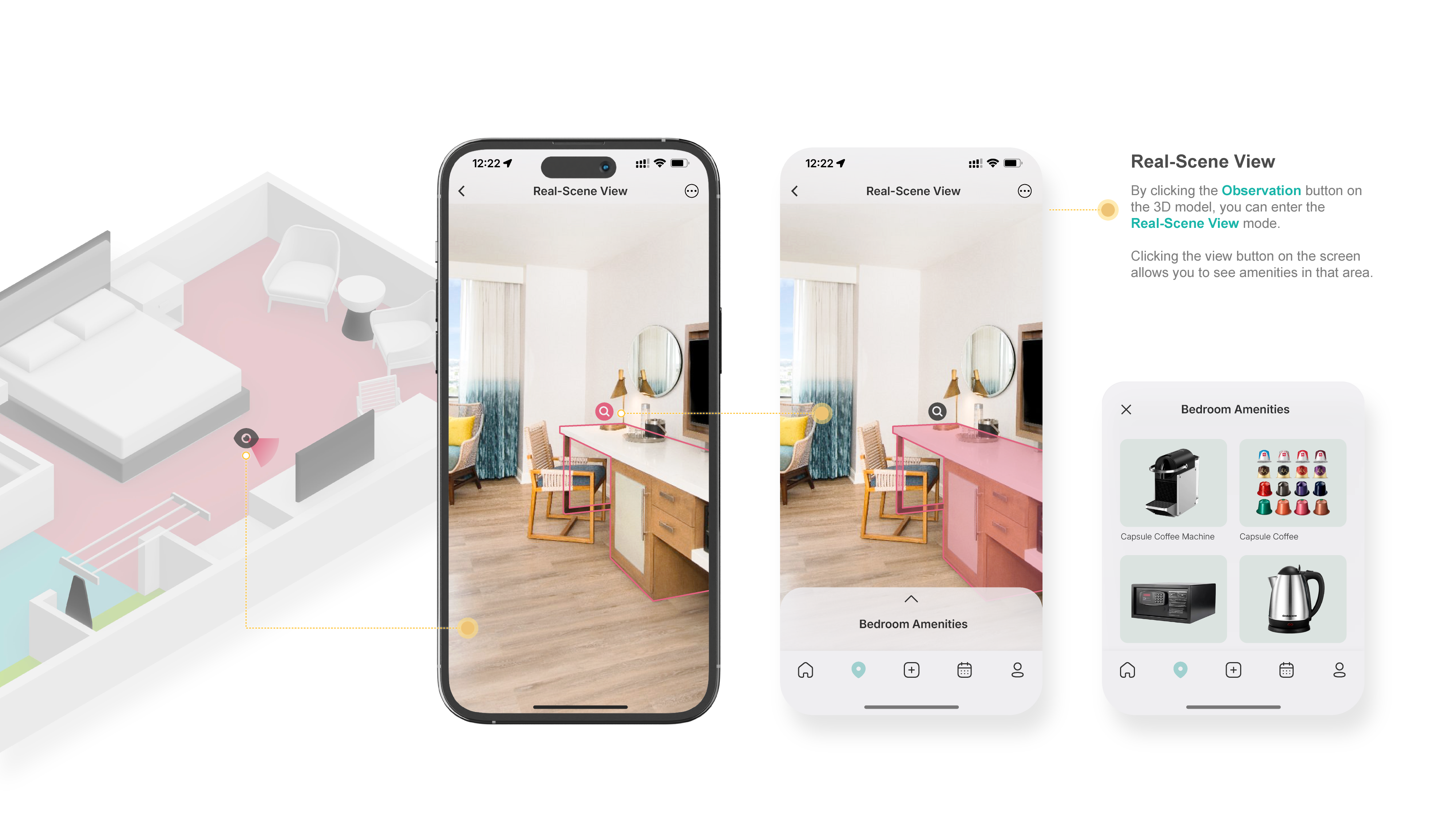
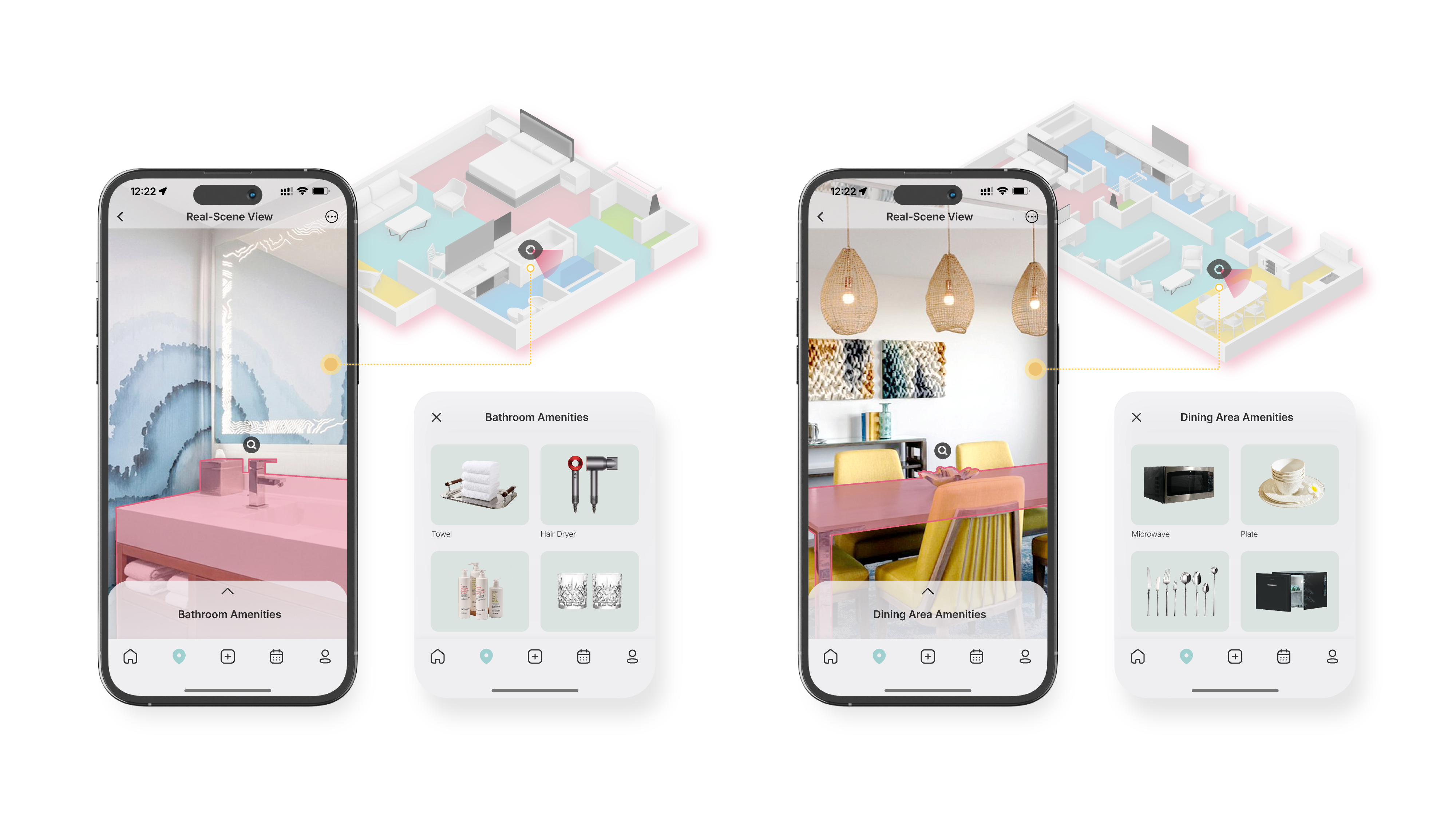
The Real-Scene View connects the simplified 3D hotel model with photographs of the actual space. Interactive observation points allow guests to inspect different areas and view the amenities associated with each location.
In the bedroom, bathroom, and dining area, guests can identify items such as the coffee machine, safe, kettle, towels, hair dryer, tableware, and appliances without searching the room or contacting staff.
Food & drinks
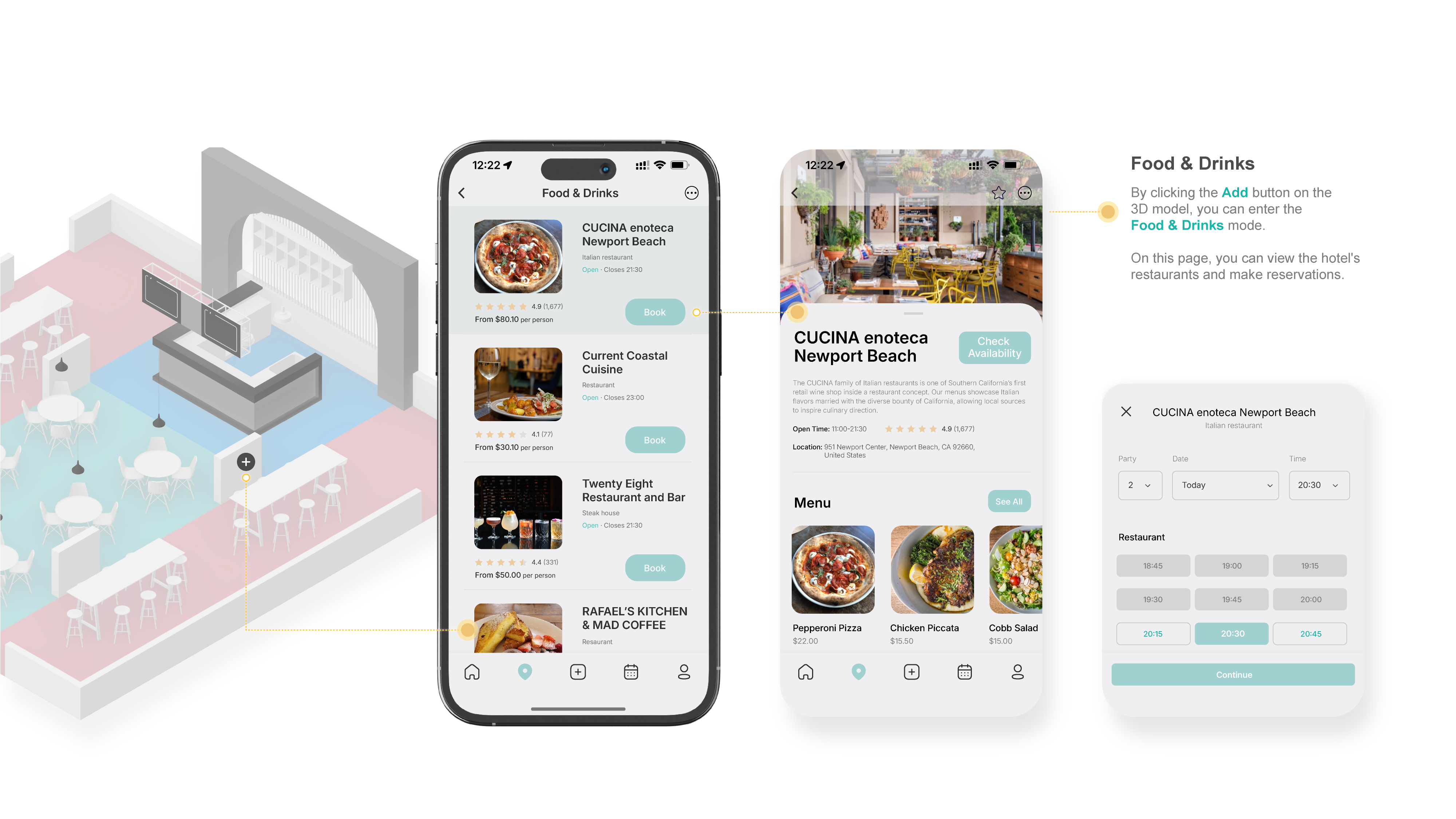
Guests can browse restaurants, compare dining options, review menus and opening information, check availability, and reserve a table. The experience brings discovery and booking into one continuous flow.
Equipment & reservation
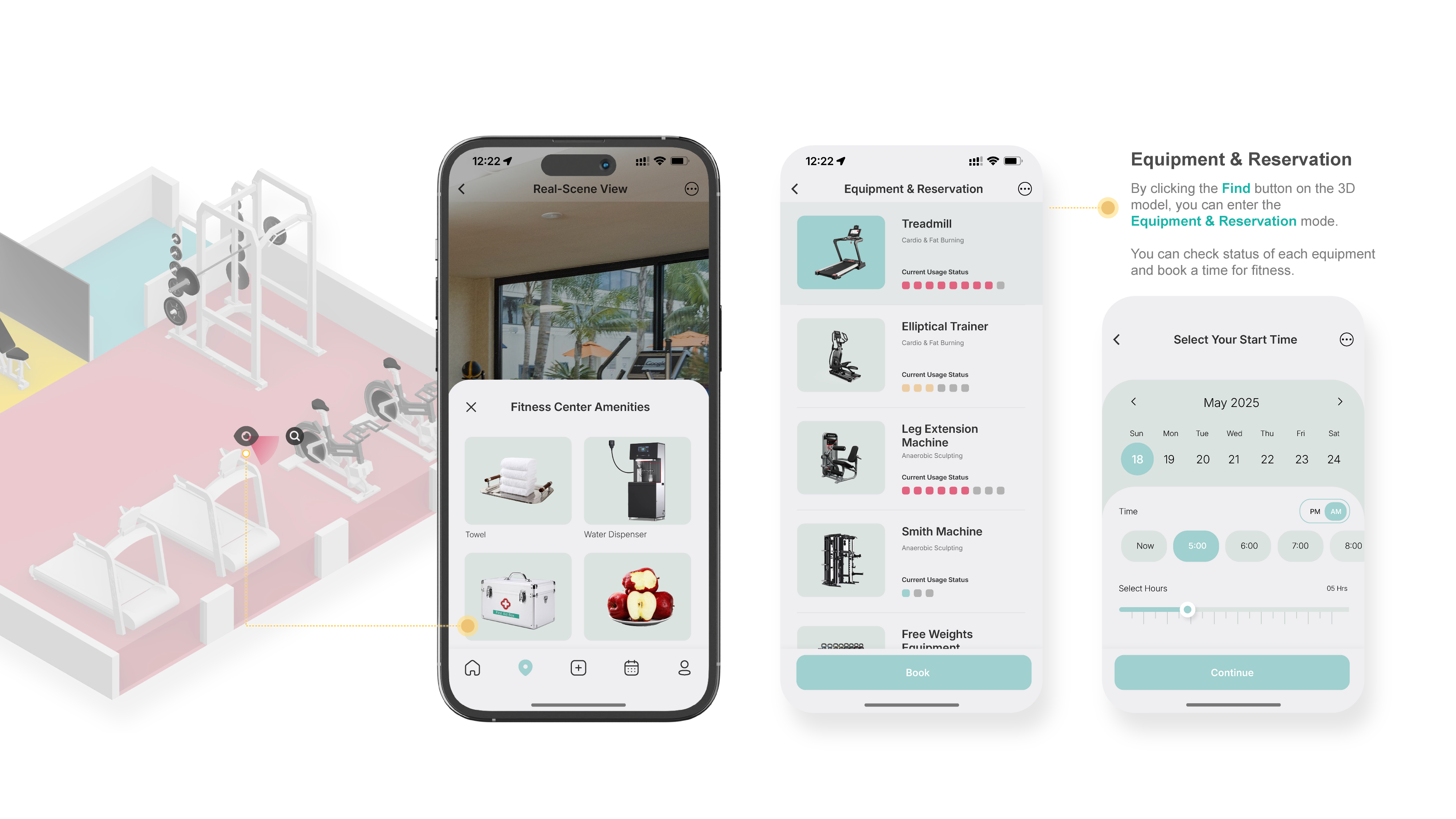
The equipment feature allows guests to view available fitness equipment, understand current usage status, and select a suitable time. This helps guests make informed decisions before walking to the facility.
Pool Area & status
The pool experience combines a real-scene view with information about nearby amenities and current conditions. Guests can review temperature, occupancy, disinfection status, and pH level before deciding when to visit.
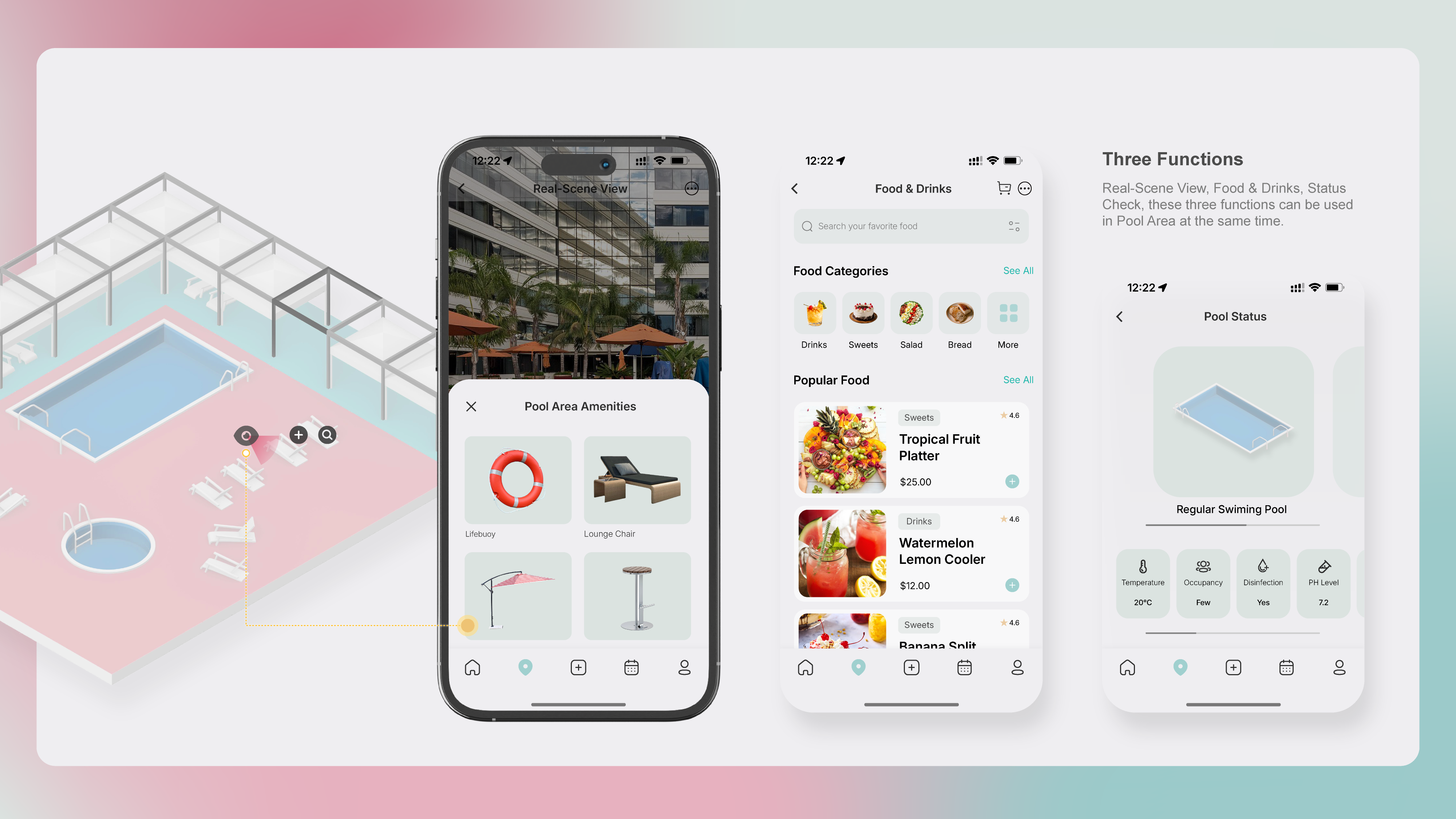
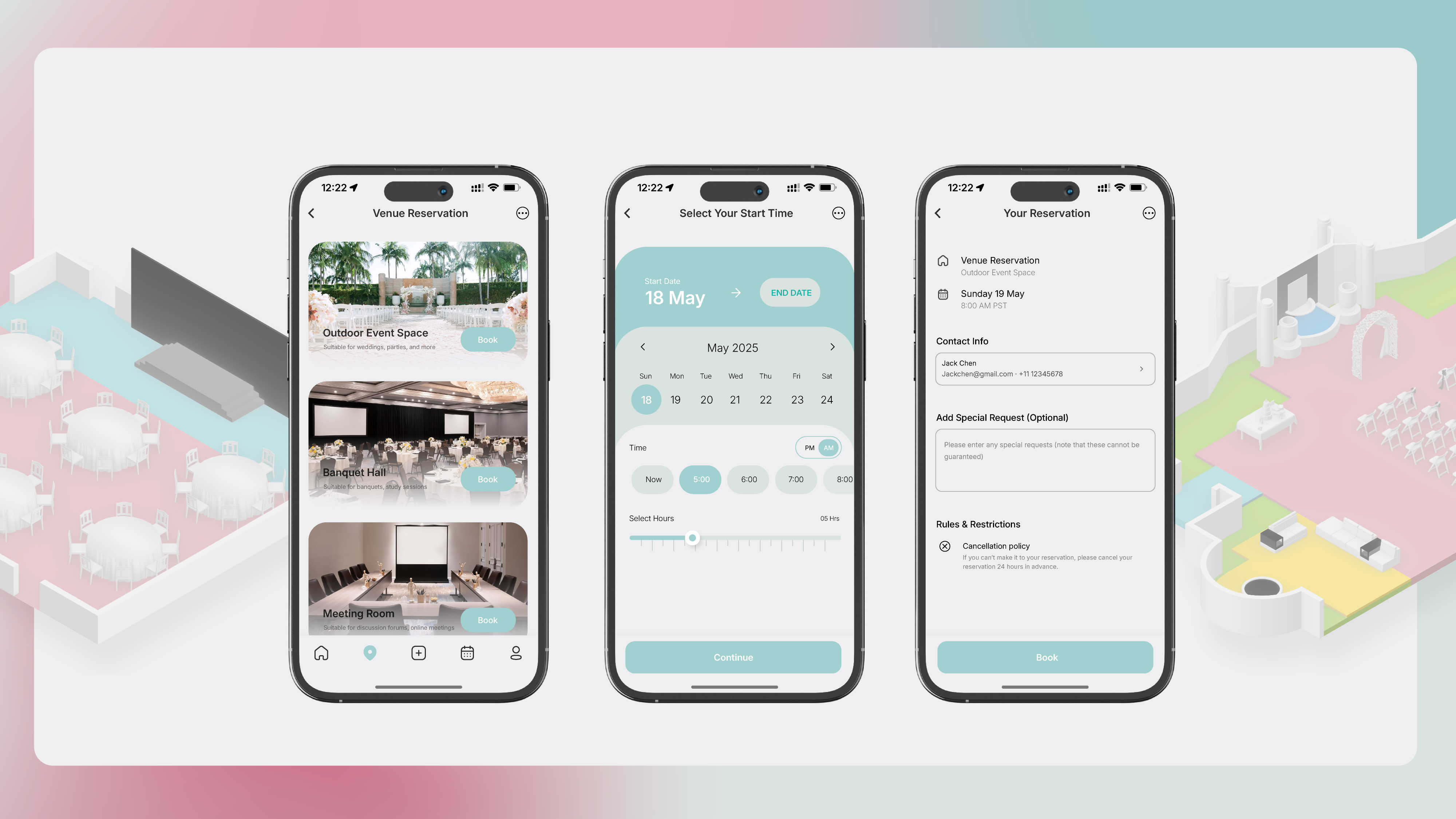
Venue reservation
Guests can browse outdoor event spaces, banquet halls, and meeting rooms, select a date and time, enter special requests, and review the reservation before confirming it.
From Design to Code
Building the product independently
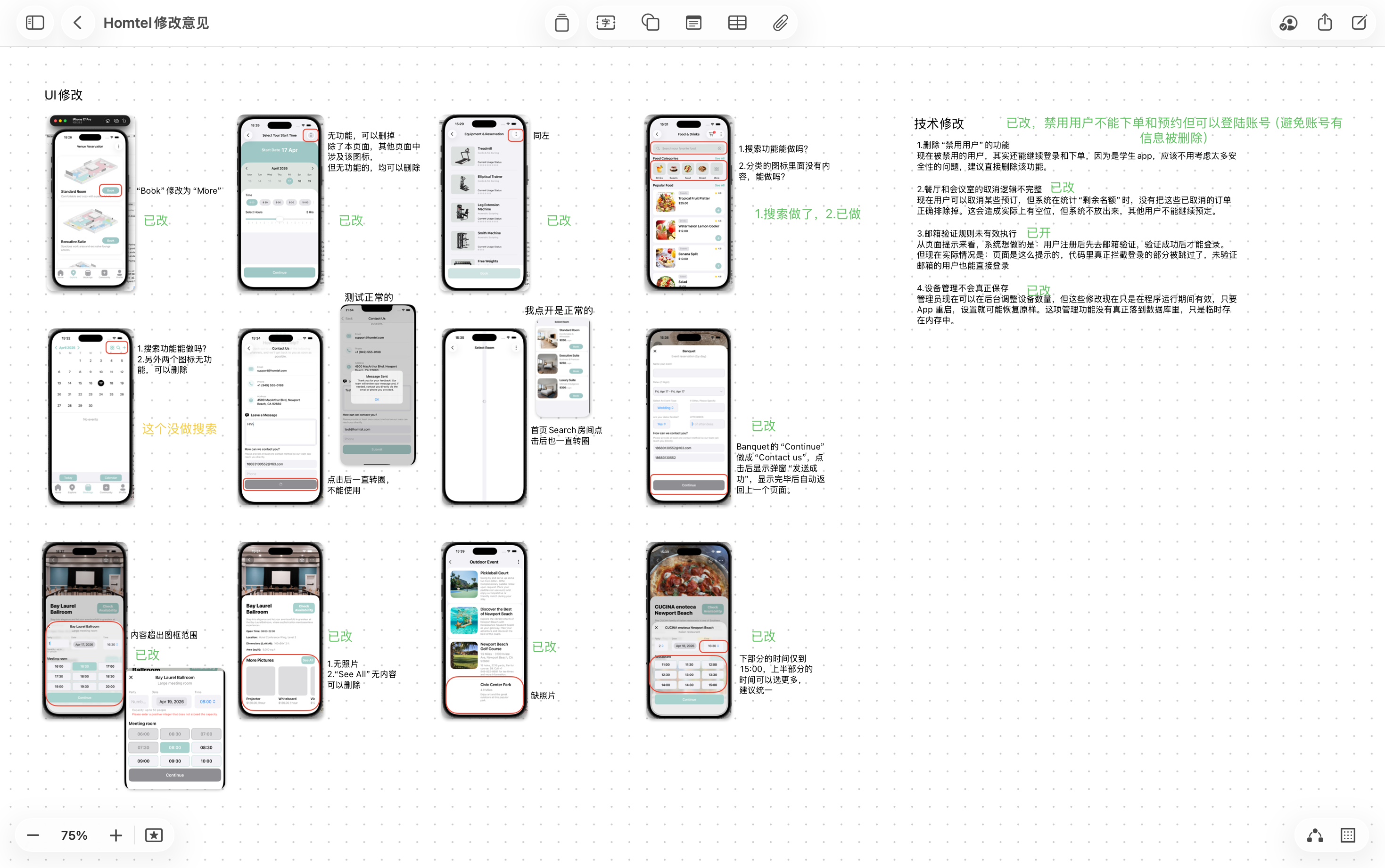
HOMTEL was my first end-to-end app project. After completing the research, spatial modeling, and interface design, I translated the visual system and interaction flows into a functioning iOS application.
I built the navigation structure, connected interface states, implemented the core guest flows, and repeatedly tested how each screen behaved outside the design file. Features that appeared simple in a static layout often required additional logic, error handling, and revisions before they felt coherent in the working product.
Because I worked independently, every stage depended on my ability to resolve the previous one. Moving from research to design, code, and release took longer than I originally expected, but it also gave me direct ownership of every major product decision.
Closing the gap between design and use
Testing HOMTEL revealed the difference between a polished interface and a usable product. I reviewed navigation, screen transitions, reservation flows, content states, and the way spatial information appeared on a real device.
When a design choice created technical limitations or unnecessary friction, I revised the interaction while preserving the original purpose of the feature. This process continued through debugging, device testing, and the final checks required before App Store submission.
The result was not a direct translation of the earliest concept. It was a refined first release shaped by the practical work of turning that concept into functioning software.
App store launch
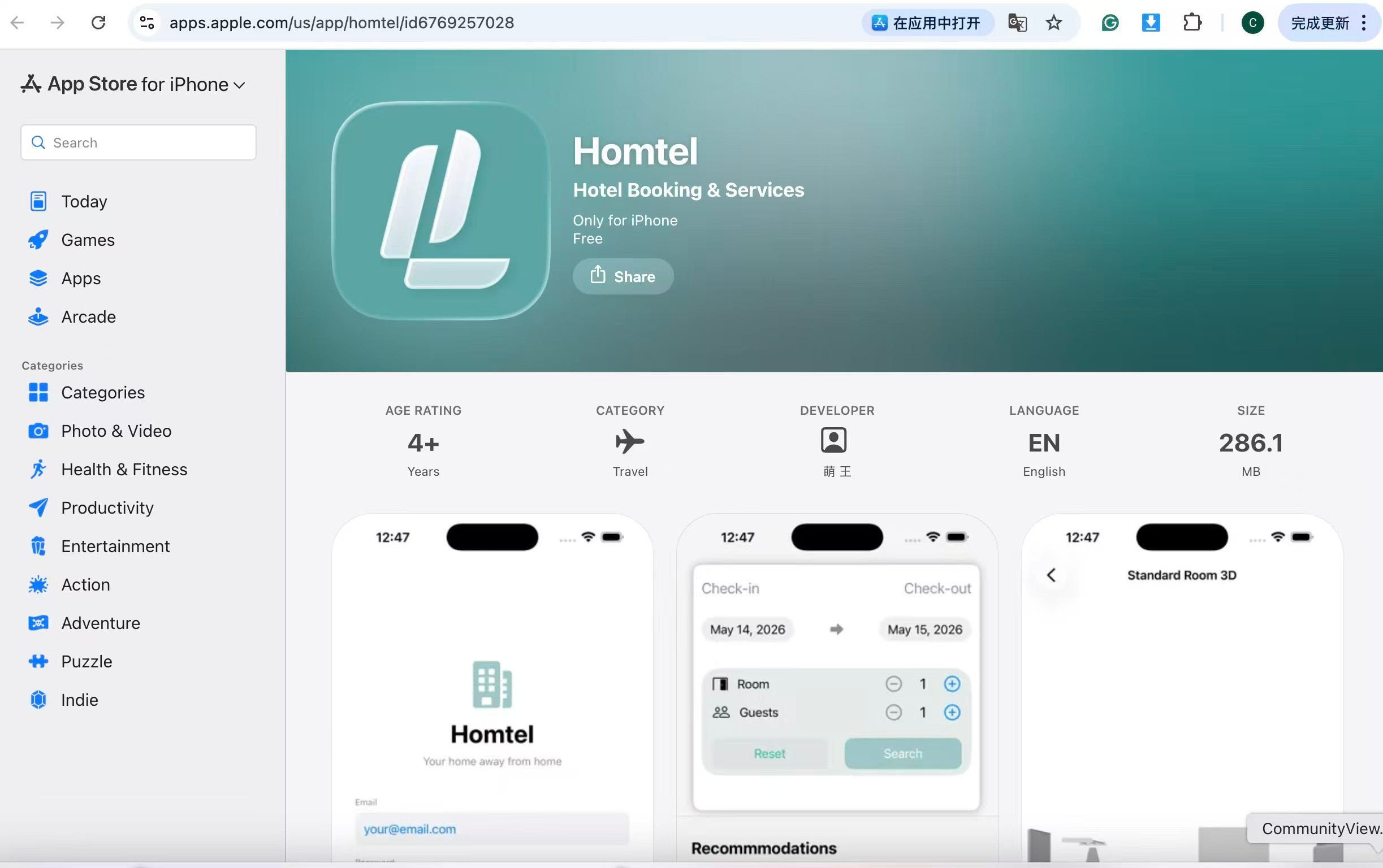
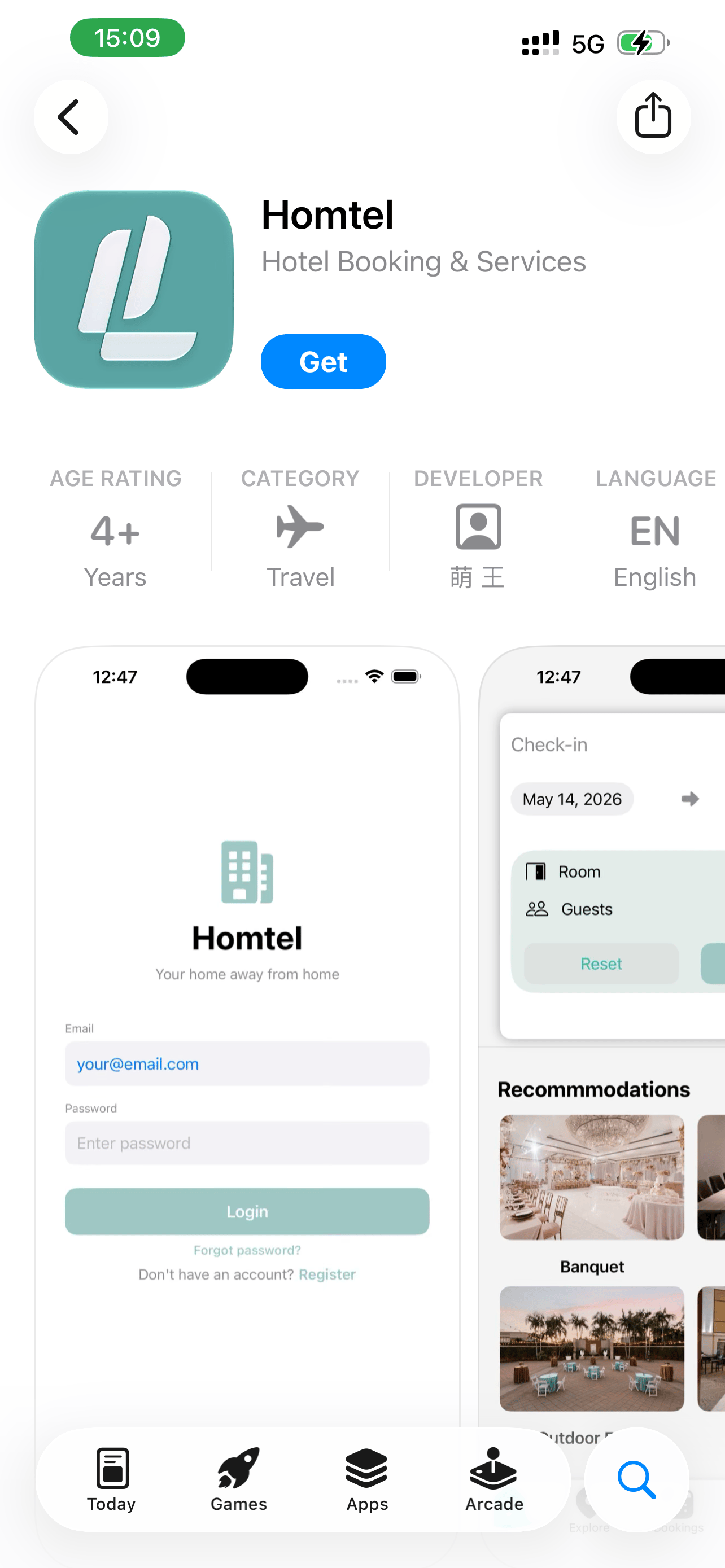
In April 2026, HOMTEL was released on the U.S. App Store. What began as an observation about hotel guests’ frustrations had developed into a publicly available iOS product.
Because I was under 18 and therefore unable to register an individual Apple Developer account using my own information, the app was published through an account registered under my older sister, Wang Meng, with her permission. While she served as the account holder, I managed the product launch process.
Completing the release required more than research and interface design. I prepared the working build, resolved technical issues, organized the product content, and completed the App Store submission and review process.
The launch marked the completion of HOMTEL’s first public version and the first time I had carried an independent product from a real-world question to a downloadable application.
What I Learned
Building more than an interface
Building HOMTEL independently taught me that designing for hospitality is not simply about creating attractive interfaces. It is about understanding how people move through unfamiliar spaces, what information they need at each moment, and how a digital product can make a physical service feel more intuitive.
Working with hotel information and floor plans provided by Renaissance helped me understand the relationship between space, operations, and guest experience. I had to translate real rooms, facilities, and service processes into a digital structure that guests could understand without additional explanation.
Taking responsibility for every stage—from research and 3D modeling to interface design, development, and App Store submission—also changed the way I approached problems. A feature that looked clear in a design file did not always work the same way in code. Each transition required me to reconsider priorities, resolve technical limitations, and preserve a coherent experience.
The project took much longer than I initially expected, but that process taught me persistence, independent decision-making, and the importance of carrying an idea beyond the concept stage. HOMTEL became more than a design project; it became my first experience building and releasing a complete product.
Next project

2026 FAYE
HOMTEL
Unlock your 100% home-like hotel experience
ROLE
Independent Product Research
UX/UI Design, 3D Modeling
iOS Development, App Store Launch
Duration
September 2024 – April 2026
PARTNER
Renaissance Hotel
Origin Story
From a hotel stay to HOMTEL
HOMTEL began with a simple observation: a hotel may offer many amenities, yet guests can still struggle to find, understand, and use them. During a stay at Renaissance Hotel, I noticed how easily small information gaps could interrupt an otherwise comfortable experience—from locating activity spaces to understanding room amenities, dining options, and facility availability.
I began the project in September 2024 with the goal of making the hotel environment easier to understand and navigate. Renaissance Hotel supported the project by providing property information and floor plans. Using those materials as a real-world foundation, I independently carried the project from research and spatial modeling to interface design, development, and release.
HOMTEL was created as my personal project. The hotel contributed essential contextual materials, while I was responsible for the product research, concept development, 3D modeling, UX/UI design, technical implementation, and App Store launch.
CHALLENGE
The guest experience problem
Since HOMTEL was the first app I developed entirely on my own—from concept to design to implementation—it was a completely new experience for me. Throughout the process, I came to realize that each stage, from conceptual thinking to interface design and then to actual coding, involves unexpected gaps that require careful integration and adjustment.
For example, while the initial concept focused on specific features or ideas, the app design phase required me to translate those into a seamless and continuous user journey. Every button, every transition demanded a deeper level of detail and refinement based on the original concept, ensuring everything fits within a coherent and functional system.
How might we help hotel guests understand and use unfamiliar spaces, amenities, and services with greater confidence?
Research
Understanding the hotel experience
The project moved from inspiration and discovery to analysis, ideation, prototyping, and execution. Each phase helped turn a broad observation into a product grounded in guest needs and a real hotel environment.
The recovery of travel and the continued importance of hotels highlighted the value guests place on cleanliness, facilities, service quality, location, and personalized experiences. These factors showed that a hotel stay is shaped not only by the room itself, but by how easily guests can understand and access the full service environment.
Existing hotel apps were effective at booking, loyalty management, check-in, and room service, but often provided limited support once guests entered the physical hotel environment. Information about exact locations, facility conditions, room equipment, and space availability remained difficult to access.
The guest stay experience questionnaire examined check-in, room quality, amenities, hotel facilities, dining, and overall satisfaction. It also asked why guests chose not to use certain facilities, including lack of awareness, unclear locations, crowding, and limited time.
The interviews revealed different priorities across leisure, business, and resort travel. Guests wanted to preview spaces and dining options, understand facility availability, reduce scheduling uncertainty, locate parking and equipment, and receive more reliable service information.
The research showed that guest frustration often came not from the absence of services, but from the absence of timely and accessible information about those services.
Key Insights
Information is part of the service
Guests need clear guidance when moving through an unfamiliar hotel environment. Facility status and availability affect how guests plan their time and whether they choose to use a service. Room amenities, shared equipment, and useful items should be easier to identify before guests need them. Dining information is most useful before a guest makes a decision, not after arriving at the restaurant. A digital product should support hotel service by making information more visible and decisions easier—not by removing the human side of hospitality.
Guest Journey
Connecting the moments of a stay
The guest journey extends beyond arrival and check-in. It continues through the room, dining, events, wellness spaces, and every decision a guest makes throughout the stay. Mapping these moments revealed where emotional highs could be interrupted by missing information or unexpected conditions.
The journey map identified three recurring opportunities: helping guests understand spaces, helping them plan ahead, and helping them act without unnecessary friction.
Product Strategy
Freedom, clarity, and flexibility
HOMTEL was designed around three principles: freedom of schedule, clear arrangement of items, and flexible use of hotel spaces. Together, these principles connect guest decisions with the physical environment of the hotel.
Guests can review dining, activities, and facility availability before deciding where to go and when to go. Guests can identify room amenities, equipment, and useful items through visual, location-based information. Guests can understand and reserve hotel spaces for dining, fitness, meetings, and events through one connected experience.
Information Architecture & User Flow
A digital layer for the hotel
Using hotel information and floor plans supplied by Renaissance Hotel, I translated physical spaces into a digital structure that connects guests with rooms, amenities, restaurants, equipment, activities, and reservable facilities.
The app begins with the hotel environment rather than a list of isolated services. Guests can move from a 3D space to a real-scene view, inspect nearby items, check facility status, browse dining options, and complete reservations.
This structure allows the digital experience to follow the way guests actually move through the hotel: from space, to information, to decision, to action.
Design Development
From floor plans to an interface
The hotel floor plans became the foundation for spatial modeling. I reconstructed key rooms and public areas, organized their functions, and connected each space with the services and information guests would need there.
The interface uses a soft pink and teal palette to distinguish areas, guide interaction, and create a sense of comfort. A consistent icon system supports search, location, booking, status, messaging, and personal account actions across the app.
From Space to Service
Real-scene view & room amenities
The Real-Scene View connects the simplified 3D hotel model with photographs of the actual space. Interactive observation points allow guests to inspect different areas and view the amenities associated with each location.
In the bedroom, bathroom, and dining area, guests can identify items such as the coffee machine, safe, kettle, towels, hair dryer, tableware, and appliances without searching the room or contacting staff.
Food & drinks
Guests can browse restaurants, compare dining options, review menus and opening information, check availability, and reserve a table. The experience brings discovery and booking into one continuous flow.
Equipment & reservation
The equipment feature allows guests to view available fitness equipment, understand current usage status, and select a suitable time. This helps guests make informed decisions before walking to the facility.
Pool Area & status
The pool experience combines a real-scene view with information about nearby amenities and current conditions. Guests can review temperature, occupancy, disinfection status, and pH level before deciding when to visit.
Venue reservation
Guests can browse outdoor event spaces, banquet halls, and meeting rooms, select a date and time, enter special requests, and review the reservation before confirming it.
From Design to Code
Building the product independently
HOMTEL was my first end-to-end app project. After completing the research, spatial modeling, and interface design, I translated the visual system and interaction flows into a functioning iOS application.
I built the navigation structure, connected interface states, implemented the core guest flows, and repeatedly tested how each screen behaved outside the design file. Features that appeared simple in a static layout often required additional logic, error handling, and revisions before they felt coherent in the working product.
Because I worked independently, every stage depended on my ability to resolve the previous one. Moving from research to design, code, and release took longer than I originally expected, but it also gave me direct ownership of every major product decision.
Closing the gap between design and use
Testing HOMTEL revealed the difference between a polished interface and a usable product. I reviewed navigation, screen transitions, reservation flows, content states, and the way spatial information appeared on a real device.
When a design choice created technical limitations or unnecessary friction, I revised the interaction while preserving the original purpose of the feature. This process continued through debugging, device testing, and the final checks required before App Store submission.
The result was not a direct translation of the earliest concept. It was a refined first release shaped by the practical work of turning that concept into functioning software.
App store launch
In April 2026, HOMTEL was released on the U.S. App Store. What began as an observation about hotel guests’ frustrations had developed into a publicly available iOS product.
Because I was under 18 and therefore unable to register an individual Apple Developer account using my own information, the app was published through an account registered under my older sister, Wang Meng, with her permission. While she served as the account holder, I managed the product launch process.
Completing the release required more than research and interface design. I prepared the working build, resolved technical issues, organized the product content, and completed the App Store submission and review process.
The launch marked the completion of HOMTEL’s first public version and the first time I had carried an independent product from a real-world question to a downloadable application.
What I Learned
Building more than an interface
Building HOMTEL independently taught me that designing for hospitality is not simply about creating attractive interfaces. It is about understanding how people move through unfamiliar spaces, what information they need at each moment, and how a digital product can make a physical service feel more intuitive.
Working with hotel information and floor plans provided by Renaissance helped me understand the relationship between space, operations, and guest experience. I had to translate real rooms, facilities, and service processes into a digital structure that guests could understand without additional explanation.
Taking responsibility for every stage—from research and 3D modeling to interface design, development, and App Store submission—also changed the way I approached problems. A feature that looked clear in a design file did not always work the same way in code. Each transition required me to reconsider priorities, resolve technical limitations, and preserve a coherent experience.
The project took much longer than I initially expected, but that process taught me persistence, independent decision-making, and the importance of carrying an idea beyond the concept stage. HOMTEL became more than a design project; it became my first experience building and releasing a complete product.
Next project
2026 FAYE