LUCKIN COFFEE STRATEGY
Finding a Growth Path Beyond the Price War
ROLE
Researcher
Presentation Lead
Report Editor
DURATION
January 24 - May 7, 2026
PROGRAM
Preparing Organizations for Greater Turbulence Online Research Seminar
OUTCOME
Total Grade A
Research Paper Accepted by ICMRED 2026
Joining the Research Seminar
Learning to Study Turbulence, Not Just Companies
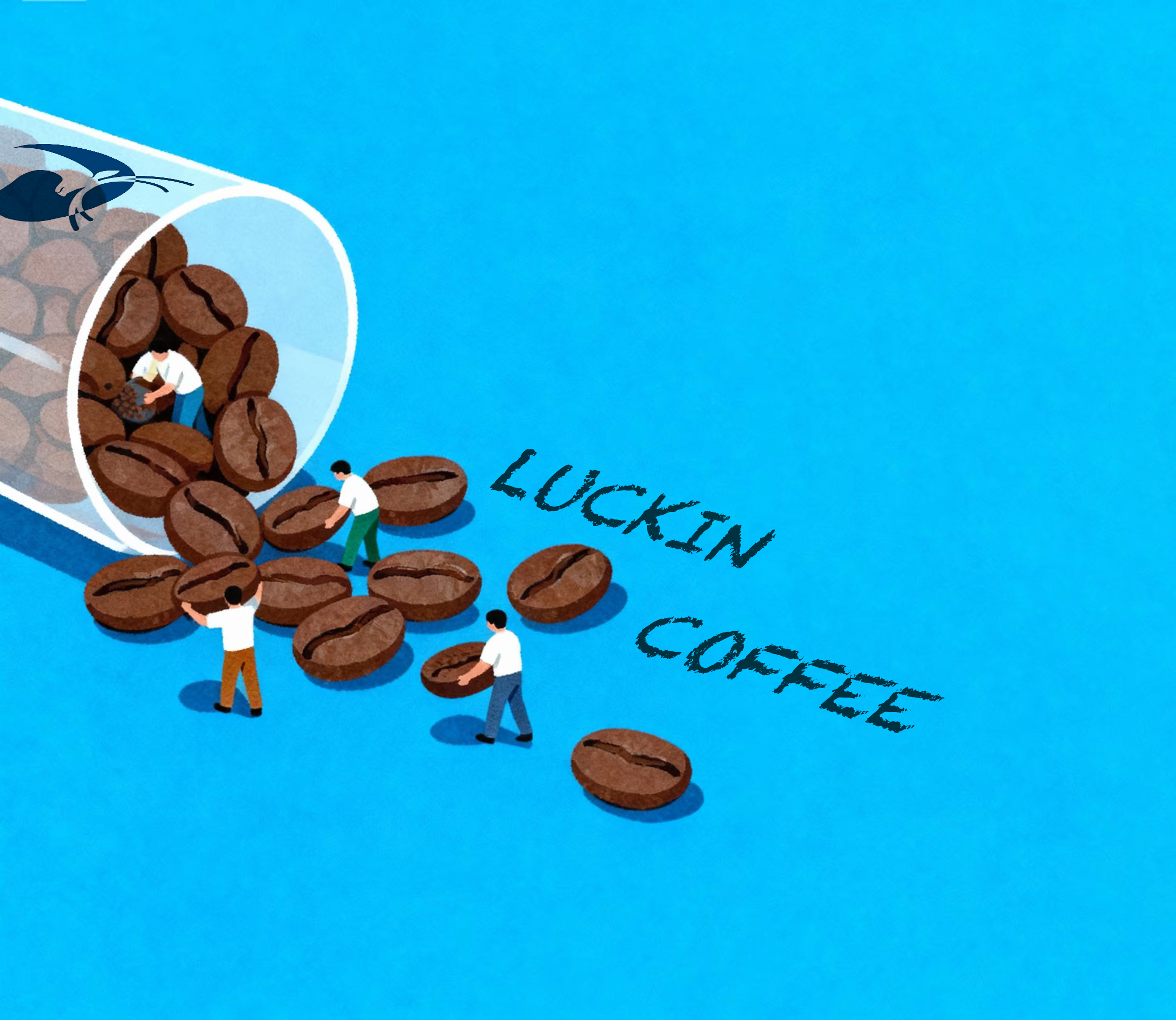
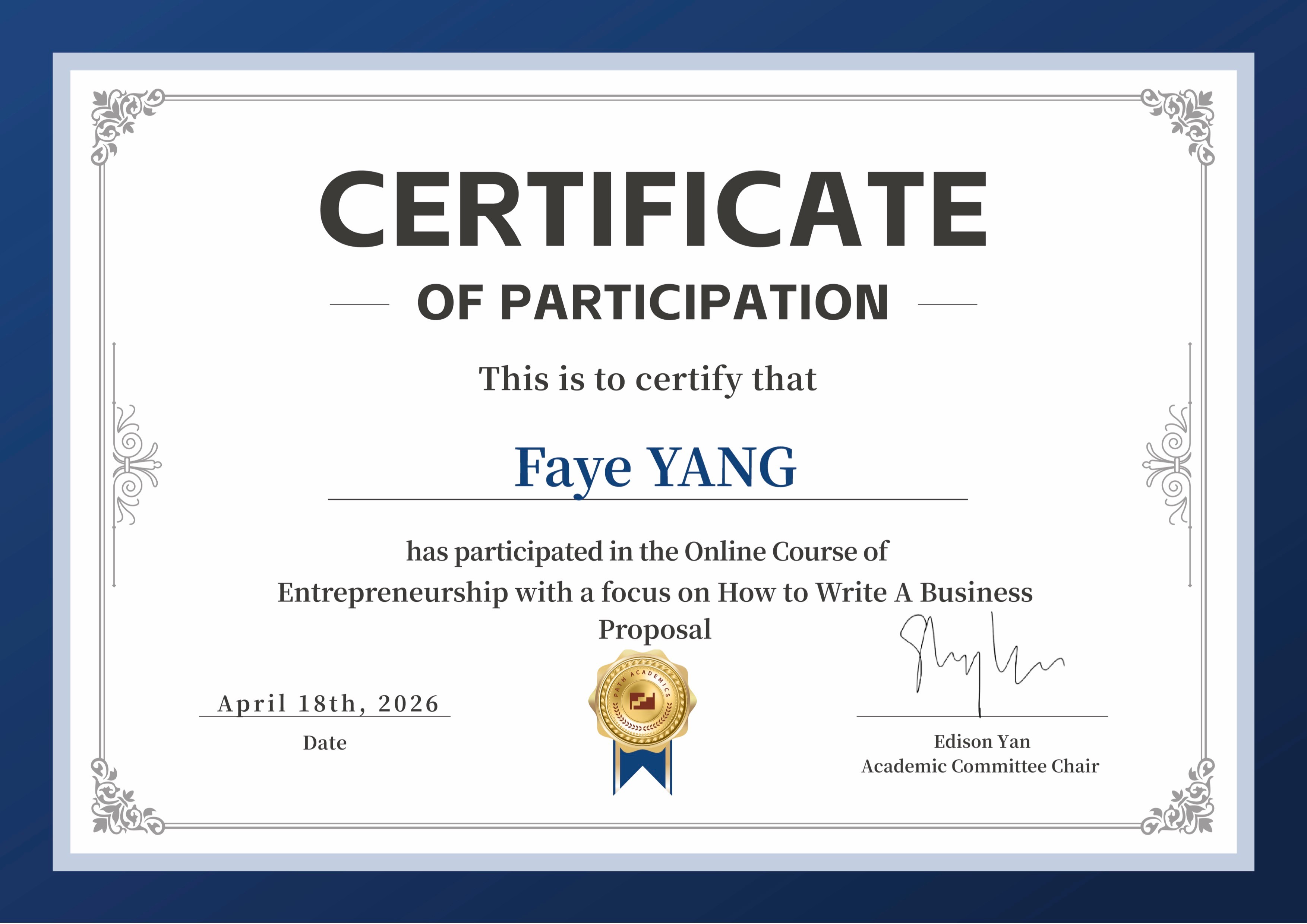
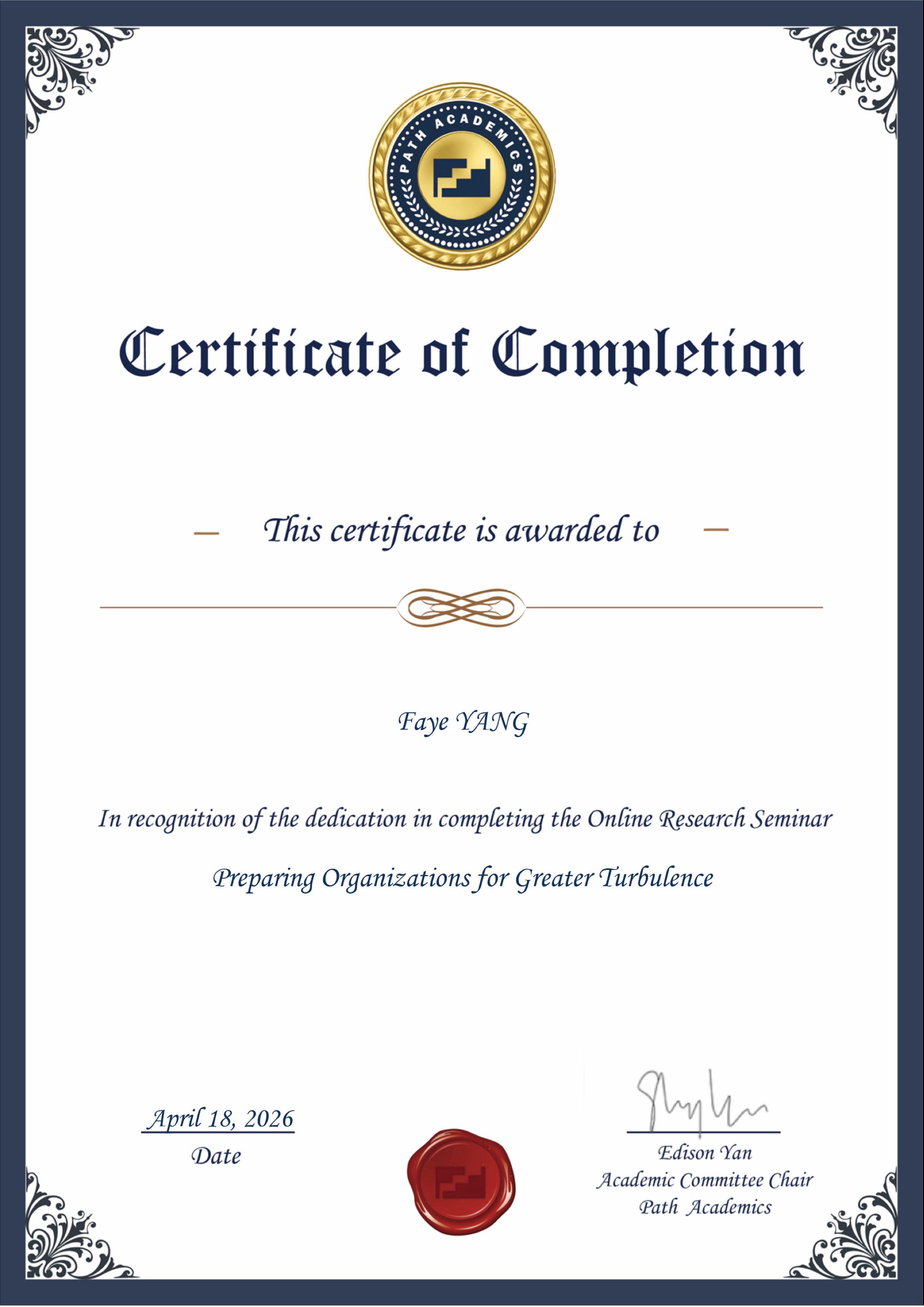
In January 2026, I joined Path Academics' Preparing Organizations for Greater Turbulence Online Research Seminar, led by Professor George S. Day. The seminar examined how digital change, economic uncertainty, market disruption, and intensifying competition affect organizations. Instead of beginning with a fixed conclusion, I learned to look for signals of change, ask how a company creates value, and consider what it must do before competitors respond. This framework became the starting point for our research project.
Why We Chose Luckin Coffee
Finding a Strategic Question Inside a Familiar Brand
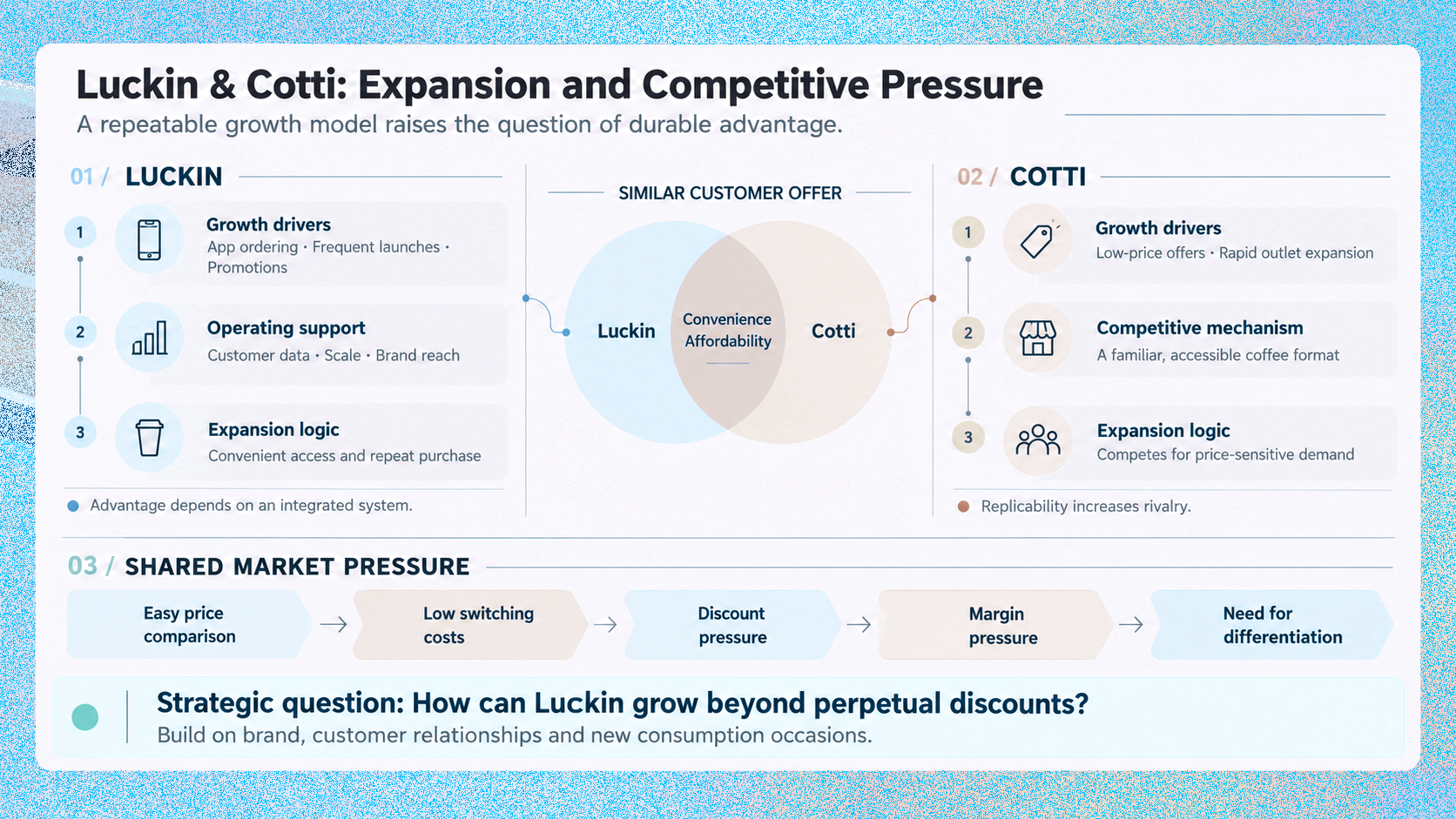
Our group wanted to study a company facing visible turbulence rather than a distant theoretical case. Luckin Coffee offered that opportunity. Its rapid expansion, app-based ordering, frequent product launches, and low-price promotions had changed how many young consumers purchased coffee in China. At the same time, Cotti Coffee's expansion showed how quickly a successful model could be copied. We began with a practical question: if customers could compare prices and switch brands with little effort, how could Luckin continue growing without relying indefinitely on discounted drinks? The topic connected a familiar consumer experience in everyday life with larger questions about digital retail, brand differentiation, operating scale, and profitability. It also allowed us to examine how a company can use existing strengths to create new consumption occasions while protecting its core business.
The Research Challenge
Turning a Fast-Moving Market into a Focused Argument
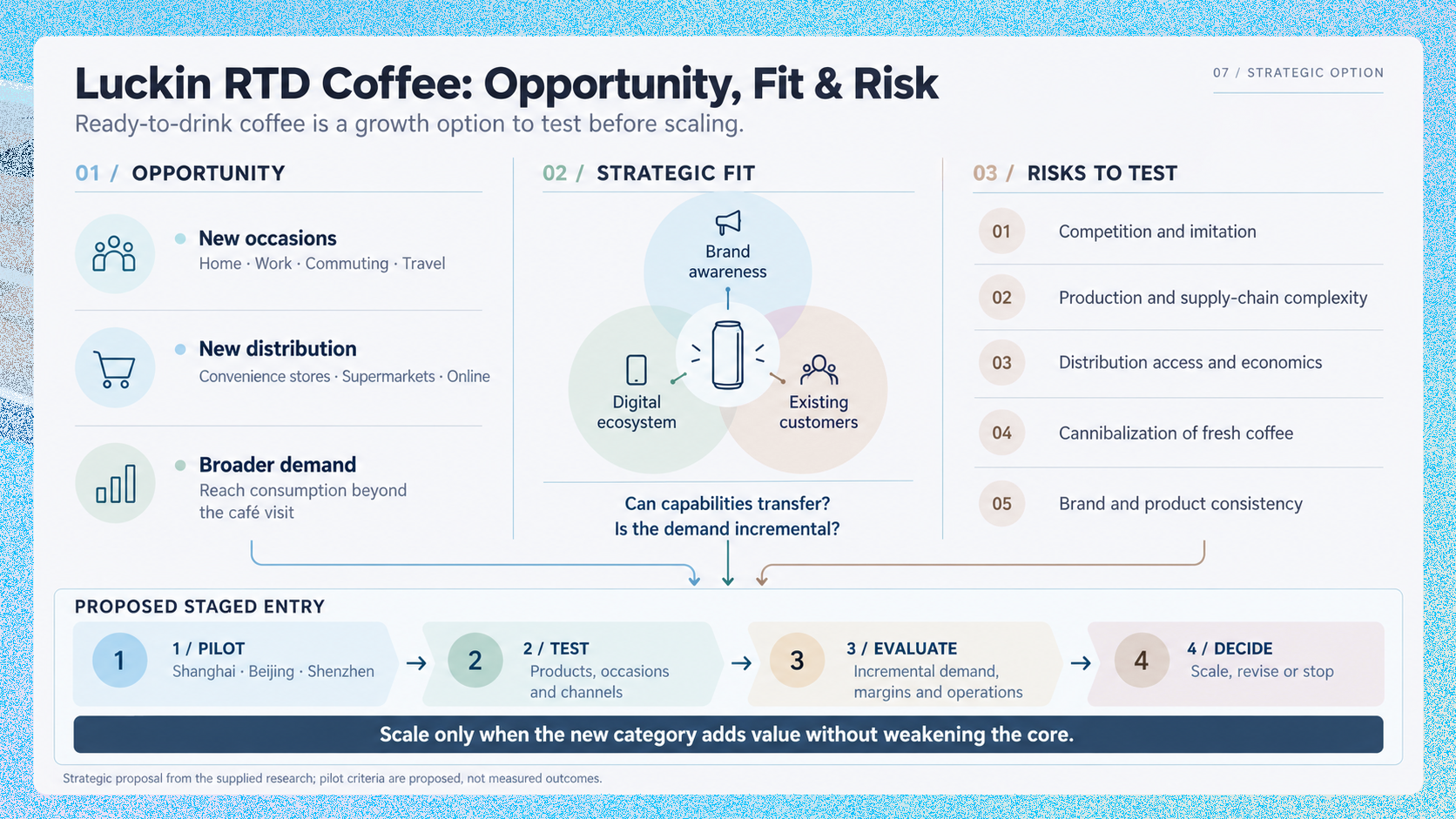
The greatest difficulty was narrowing a broad and rapidly changing market into one defensible strategic question. China's coffee industry involved consumer habits, store expansion, digital ordering, branding, pricing, supply chains, and new product categories. Treating every trend as equally important would have produced a descriptive report rather than a useful recommendation. I therefore worked to connect the evidence in a logical sequence: low switching costs intensified the price war; repeated discounting placed pressure on profitability; and Luckin needed a growth path that used its brand, digital ecosystem, and customer base without simply repeating its store-based model. Evaluating ready-to-drink coffee created another challenge because an attractive market did not automatically mean strategic fit. We had to compare opportunity with competition, production complexity, channel requirements, cannibalization, and the risk of entering another easily copied category.
Collaboration & My Contribution
Building One Story from Different Contributions
The final project combined research, an oral presentation, and a written report, so collaboration required more than dividing sections among group members. Different analyses had to support one central recommendation. I helped organize the argument around value creation and competitive positioning, then took a leading role in designing the presentation slides and preparing the speaking script. For the written report, I drafted the introduction and refined the content so that the market background, competitive analysis, risks, and recommendation followed the same logic. When ideas overlapped or moved in different directions, I compared each section with the main research question and worked with my teammates to resolve repetition and gaps. Coordinating the presentation and report taught me how to respect individual contributions while maintaining a shared structure, consistent terminology, and a professional standard across the final submission.
Strategic Conclusion
Our analysis identified ready-to-drink coffee as a possible growth path because it could extend Luckin into homes, workplaces, commutes, and travel while using the brand's existing awareness and digital reach. However, the recommendation was not immediate national expansion. RTD coffee would introduce established packaged-beverage competitors, production and supply-chain requirements, new distribution relationships, and possible overlap with Luckin's freshly brewed products. We therefore proposed a staged pilot in major cities such as Shanghai, Beijing, and Shenzhen. Luckin stores, convenience stores, supermarkets, online platforms, and social media could be used to test different products, occasions, channels, and messages. This approach treated strategy as a sequence of evidence-based decisions: begin with a focused experiment, learn from customer response and operational performance, and scale only when the new category creates incremental value without weakening the core business.
Click to read the full paper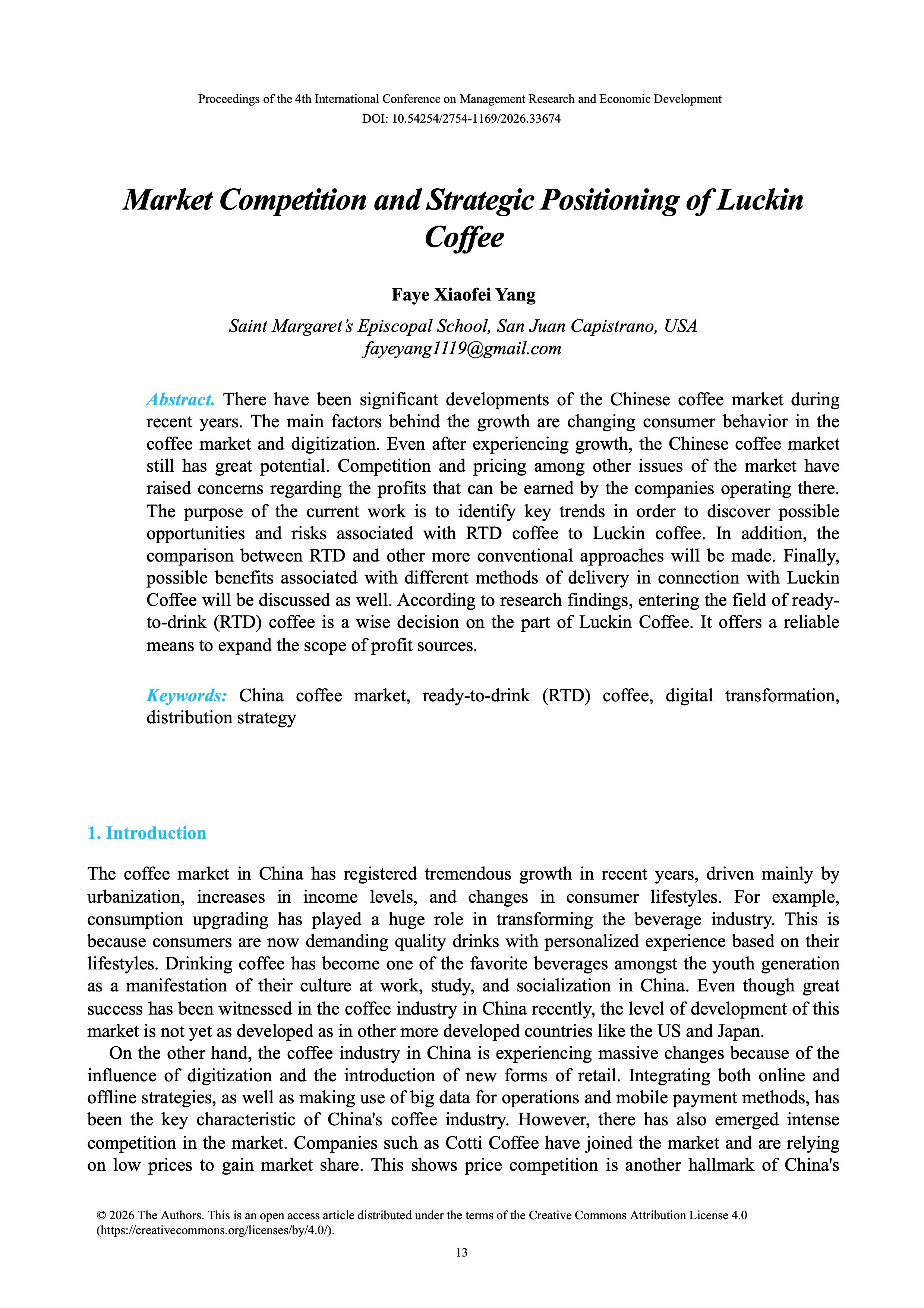
Outcomes & Recognition
What the Work Led To
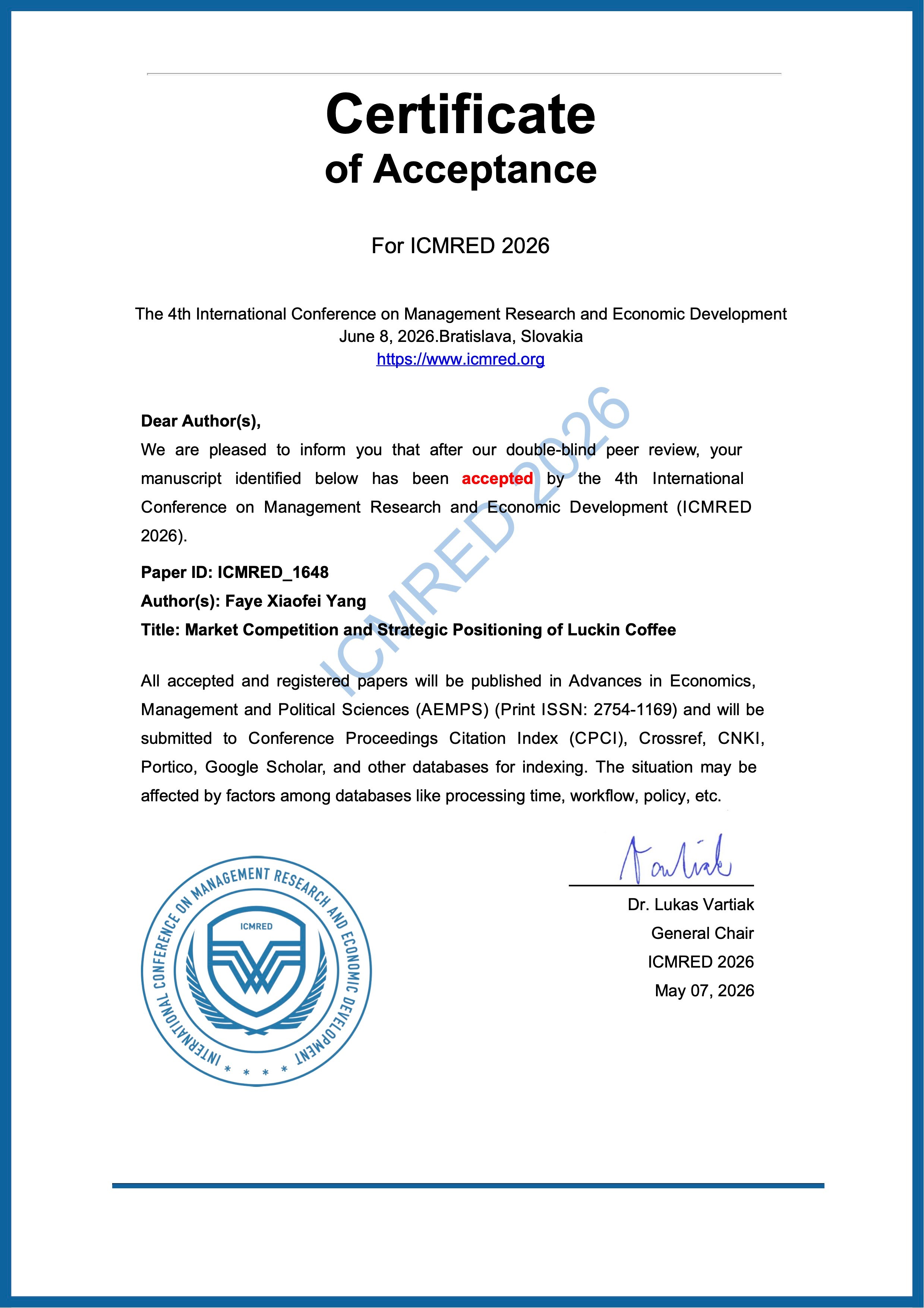
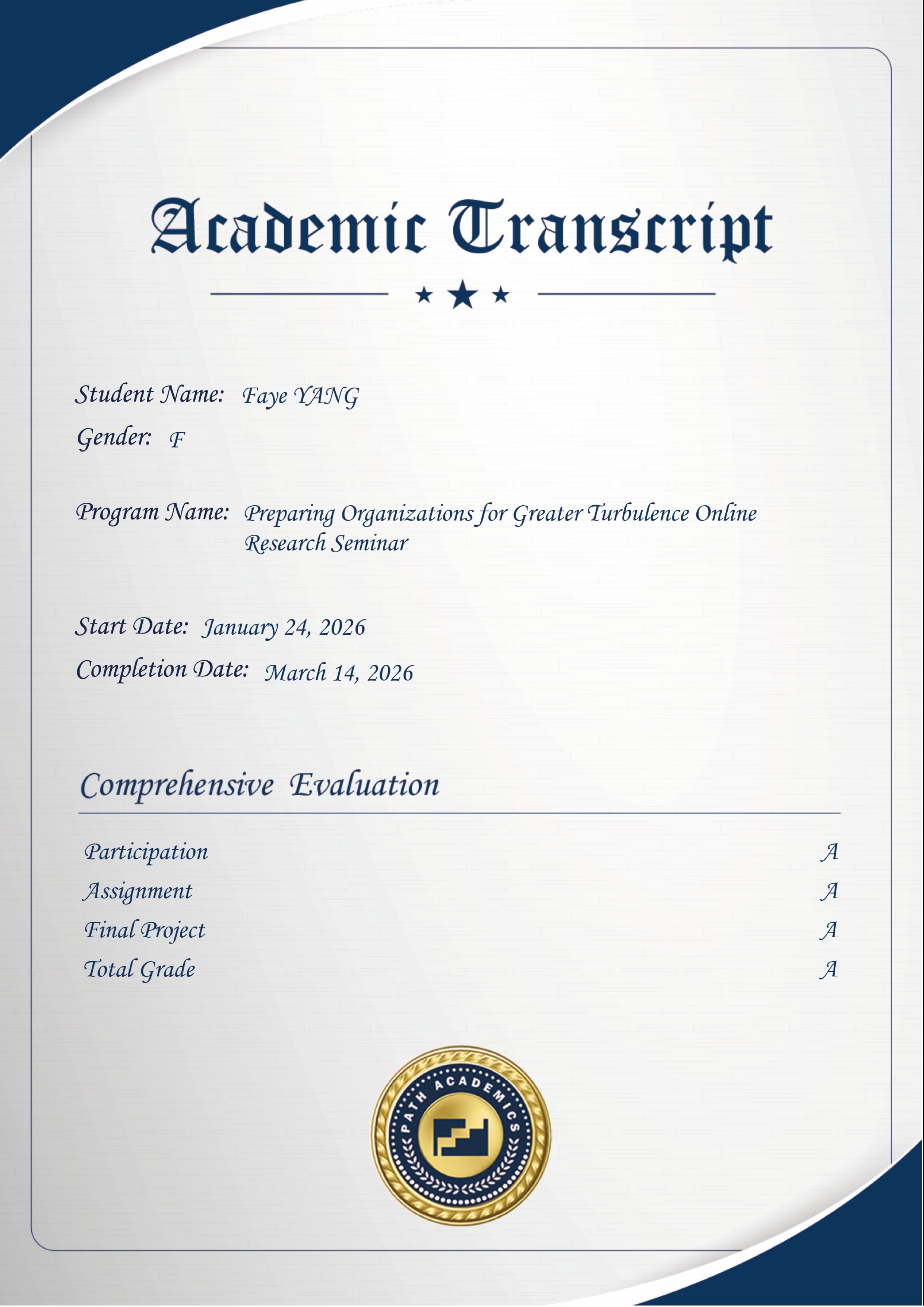
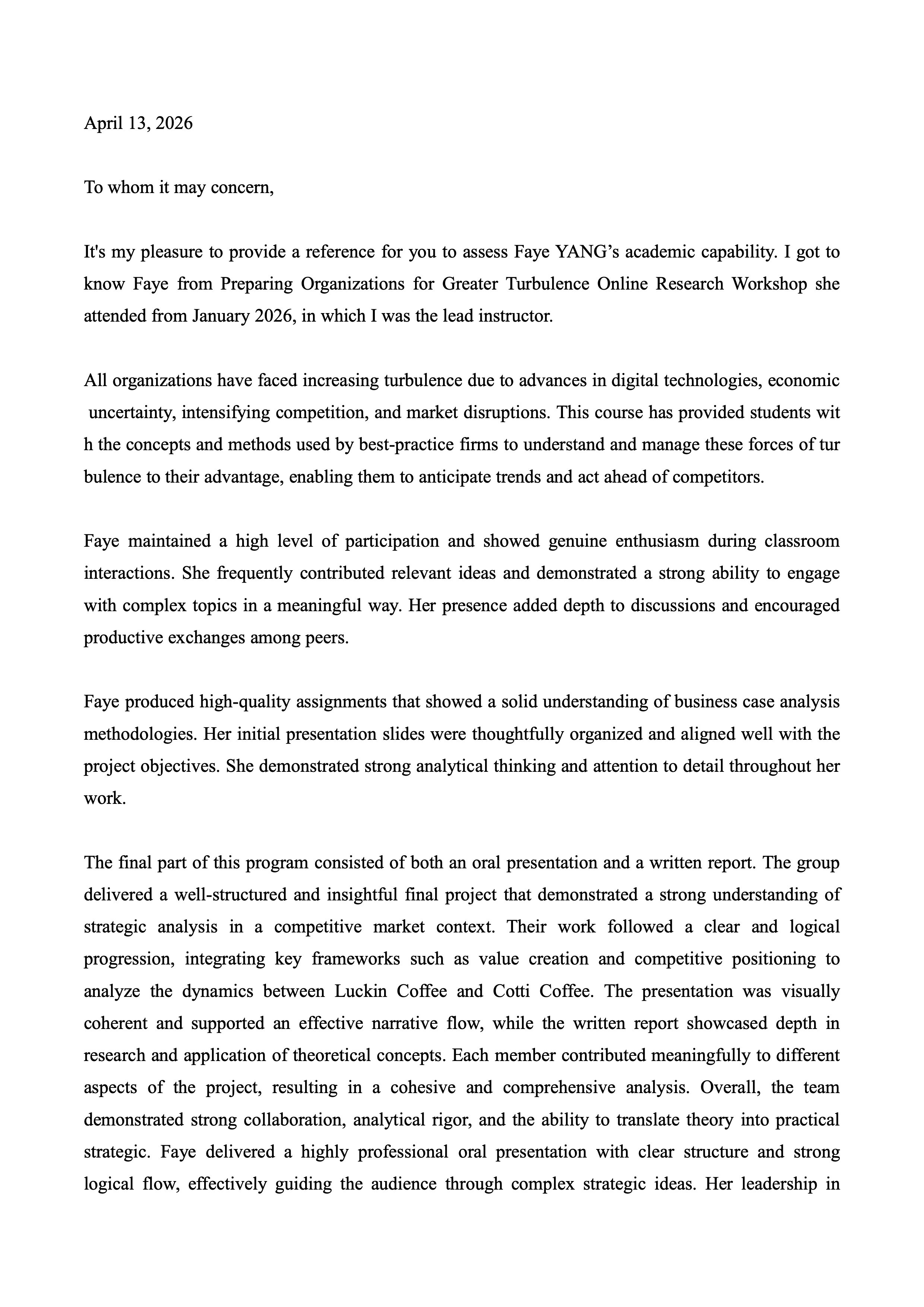
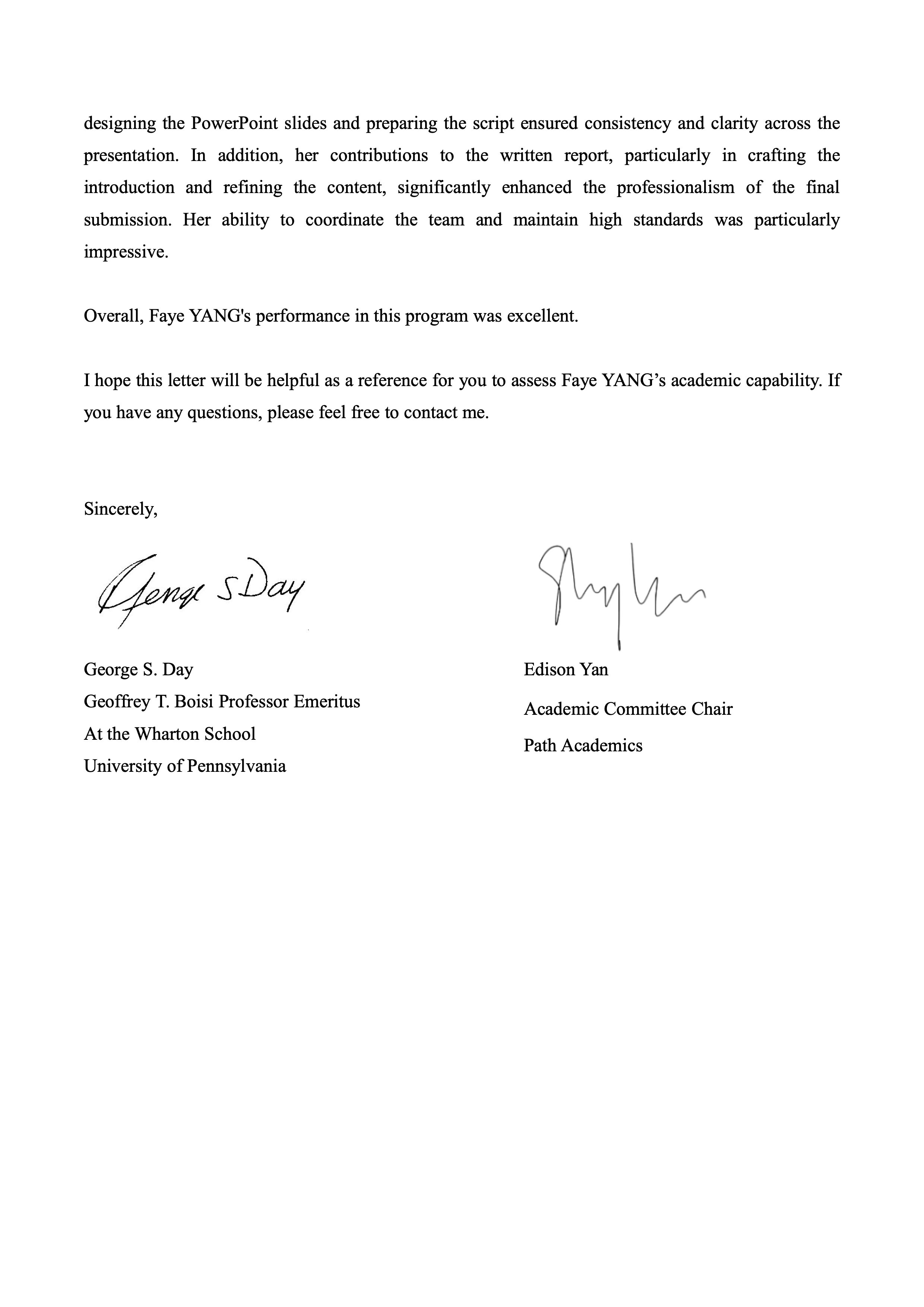
The project produced three forms of evidence. First, my academic transcript records an A for participation, assignments, the final project, and the overall seminar. Second, Professor Day's reference letter describes my engagement in discussion, analytical work, presentation structure, slide design, script preparation, report editing, and coordination within the group. It specifically notes that my work improved the consistency and professionalism of the final presentation and report. Third, I developed the research into “Market Competition and Strategic Positioning of Luckin Coffee,” which was accepted after double-blind peer review by ICMRED 2026. Together, the grade, recommendation, and acceptance show different dimensions of the project: sustained performance during the course, a documented individual contribution to collaborative work, and an external research outcome. The seminar was organized by Path Academics and should not be presented as an official University of Pennsylvania or Wharton program.
What I Learned
Strategy Is Both Analysis and Coordination
I learned that strong research depends on more than finding information. A team must agree on the question, test whether each section supports it, and turn separate contributions into one argument. I also learned to distinguish an interesting market trend from a viable strategy by examining fit, risk, and implementation. Most importantly, I became more comfortable revising my own ideas in response to a shared framework, instructor guidance, and the needs of the final presentation.
Next project

2026 FAYE
LUCKIN COFFEE STRATEGY
Finding a Growth Path Beyond the Price War
ROLE
Researcher
Presentation Lead
Report Editor
DURATION
January 24 - May 7, 2026
PROGRAM
Preparing Organizations for Greater Turbulence Online Research Seminar
OUTCOME
Total Grade A
Research Paper Accepted by ICMRED 2026
Joining the Research Seminar
Learning to Study Turbulence, Not Just Companies
In January 2026, I joined Path Academics' Preparing Organizations for Greater Turbulence Online Research Seminar, led by Professor George S. Day. The seminar examined how digital change, economic uncertainty, market disruption, and intensifying competition affect organizations. Instead of beginning with a fixed conclusion, I learned to look for signals of change, ask how a company creates value, and consider what it must do before competitors respond. This framework became the starting point for our research project.
Why We Chose Luckin Coffee
Finding a Strategic Question Inside a Familiar Brand
Our group wanted to study a company facing visible turbulence rather than a distant theoretical case. Luckin Coffee offered that opportunity. Its rapid expansion, app-based ordering, frequent product launches, and low-price promotions had changed how many young consumers purchased coffee in China. At the same time, Cotti Coffee's expansion showed how quickly a successful model could be copied. We began with a practical question: if customers could compare prices and switch brands with little effort, how could Luckin continue growing without relying indefinitely on discounted drinks? The topic connected a familiar consumer experience in everyday life with larger questions about digital retail, brand differentiation, operating scale, and profitability. It also allowed us to examine how a company can use existing strengths to create new consumption occasions while protecting its core business.
The Research Challenge
Turning a Fast-Moving Market into a Focused Argument
The greatest difficulty was narrowing a broad and rapidly changing market into one defensible strategic question. China's coffee industry involved consumer habits, store expansion, digital ordering, branding, pricing, supply chains, and new product categories. Treating every trend as equally important would have produced a descriptive report rather than a useful recommendation. I therefore worked to connect the evidence in a logical sequence: low switching costs intensified the price war; repeated discounting placed pressure on profitability; and Luckin needed a growth path that used its brand, digital ecosystem, and customer base without simply repeating its store-based model. Evaluating ready-to-drink coffee created another challenge because an attractive market did not automatically mean strategic fit. We had to compare opportunity with competition, production complexity, channel requirements, cannibalization, and the risk of entering another easily copied category.
Collaboration & My Contribution
Building One Story from Different Contributions
The final project combined research, an oral presentation, and a written report, so collaboration required more than dividing sections among group members. Different analyses had to support one central recommendation. I helped organize the argument around value creation and competitive positioning, then took a leading role in designing the presentation slides and preparing the speaking script. For the written report, I drafted the introduction and refined the content so that the market background, competitive analysis, risks, and recommendation followed the same logic. When ideas overlapped or moved in different directions, I compared each section with the main research question and worked with my teammates to resolve repetition and gaps. Coordinating the presentation and report taught me how to respect individual contributions while maintaining a shared structure, consistent terminology, and a professional standard across the final submission.
Strategic Conclusion
Our analysis identified ready-to-drink coffee as a possible growth path because it could extend Luckin into homes, workplaces, commutes, and travel while using the brand's existing awareness and digital reach. However, the recommendation was not immediate national expansion. RTD coffee would introduce established packaged-beverage competitors, production and supply-chain requirements, new distribution relationships, and possible overlap with Luckin's freshly brewed products. We therefore proposed a staged pilot in major cities such as Shanghai, Beijing, and Shenzhen. Luckin stores, convenience stores, supermarkets, online platforms, and social media could be used to test different products, occasions, channels, and messages. This approach treated strategy as a sequence of evidence-based decisions: begin with a focused experiment, learn from customer response and operational performance, and scale only when the new category creates incremental value without weakening the core business.
Click to read the full paperOutcomes & Recognition
What the Work Led To
The project produced three forms of evidence. First, my academic transcript records an A for participation, assignments, the final project, and the overall seminar. Second, Professor Day's reference letter describes my engagement in discussion, analytical work, presentation structure, slide design, script preparation, report editing, and coordination within the group. It specifically notes that my work improved the consistency and professionalism of the final presentation and report. Third, I developed the research into “Market Competition and Strategic Positioning of Luckin Coffee,” which was accepted after double-blind peer review by ICMRED 2026. Together, the grade, recommendation, and acceptance show different dimensions of the project: sustained performance during the course, a documented individual contribution to collaborative work, and an external research outcome. The seminar was organized by Path Academics and should not be presented as an official University of Pennsylvania or Wharton program.
What I Learned
Strategy Is Both Analysis and Coordination
I learned that strong research depends on more than finding information. A team must agree on the question, test whether each section supports it, and turn separate contributions into one argument. I also learned to distinguish an interesting market trend from a viable strategy by examining fit, risk, and implementation. Most importantly, I became more comfortable revising my own ideas in response to a shared framework, instructor guidance, and the needs of the final presentation.
Next project
2026 FAYE